How to Hire Verified MEP Workers from India for GCC Projects: A Complete Guide for Employers
GCC countries are in the middle of one of the biggest infrastructure expansions in their history. Saudi Arabia's Vision 2030, Expo-related developments in the UAE, and ongoing mega-projects in Qatar and Kuwait have created an enormous demand for skilled MEP workers — electricians, plumbers, HVAC technicians, and mechanical engineers.
But here's the problem: the demand is outpacing supply. Project managers across the region are struggling to find enough qualified, trade-tested MEP workers, and the few they do find often don't meet site-ready standards.
If you're an MEP contractor or project director in the GCC, you've likely dealt with at least one of these:
Workers who arrive on site without the skill level they were hired for
Delays in mobilisation that push your project timeline back
Recruitment agencies that overpromise and underdeliver
1. Why Unverified Workers Are Costing You More Than You Think
Hiring an unverified MEP worker isn't just a productivity problem — it's a financial one. When a worker arrives on site without the right skills, the cost goes beyond their salary.
Downtime while you source a replacement
Visa and travel costs that can't be recovered
Risk of site safety incidents due to inadequate training
Delays that trigger penalty clauses in your project contracts
The root cause is almost always the same: workers were not properly tested before being sent. A verified MEP workerone who has passed a rigorous trade test before departure reduces all of these risks significantly.
2. Why India Is the Top Source for MEP Talent in the GCC
India has long been the primary source of MEP manpower for the GCC, and for good reason. Indian MEP workers bring a combination of technical training, English proficiency, and adaptability that is hard to match.
India produces hundreds of thousands of ITI and polytechnic-trained electricians, plumbers, and HVAC technicians every year
Many have prior GCC experience and understand Gulf site standards
Recruitment from India is well-regulated, with clear visa pathways and government oversight
India's diverse workforce means you can source workers from states with specific trade specialisations — Kerala for plumbing, Rajasthan for civil-linked MEP, and more
3. What 'Verified' Actually Means — and What to Look for in a Recruitment Agency
Not all recruitment agencies use the same standards. When an agency says their workers are 'verified', it's worth asking exactly what that means.
At Max International, verification means:
Hands-on trade testing at our in-house Testing Centres across India — not just document checks
Background checks and employment history verification
Medical clearance before travel
Full visa and documentation processing - so workers arrive compliant and ready
When evaluating any overseas recruitment agency, ask to see their testing process. If they can't show you one, that's your answer.
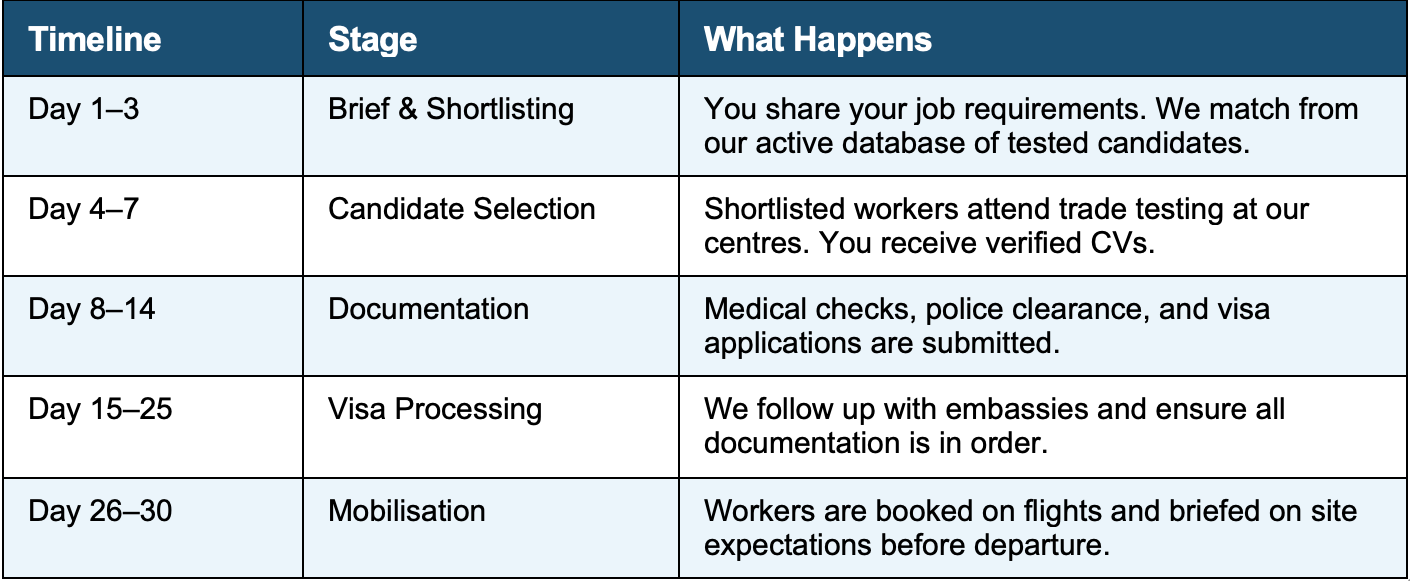
4. The End-to-End Hiring Process: From Brief to Site in 30 Days
One of the biggest concerns employers have about overseas recruitment is time. Here's how a typical MEP recruitment drive works with Max International
5. What to Prepare Before You Call a Recruitment Agency
The more clearly you define your needs upfront, the faster and smoother your recruitment drive will be. Before reaching out, have the following ready:
Number of workers required and trade categories (e.g. 20 electricians, 10 plumbers)
Skill level required — helper, tradesman, foreman, or supervisor
Project location and start date
Visa type and any specific country requirements
Accommodation and site facilities available for workers
Ready to Hire? Here's How to Get Started with Max International
Max International has been connecting GCC employers with verified, trade-tested workers from South Asia for over 20 years. We are licensed by the Ministry of External Affairs, Government of India, and the Department of Economic Development, Government of Dubai, so you can trust that every placement is fully compliant.
Whether you need 10 MEP workers or 200, we handle the entire process — sourcing, testing, documentation, visa, and mobilisationson.
Frequently Asked Questions
Q: How many MEP workers can be mobilised in 30 days?
It depends on your requirements and the destination country. For standard GCC projects, a specialist recruitment agency can typically mobilise pre-screened workers within 4 to 8 weeks of job order confirmation, and bulk orders with clear briefs tend to move faster. The key is starting the process before you feel ready, not after.
Q: Does Saudization or Emiratisation affect hiring MEP workers from India?
Yes, and it is important to plan around it. Saudi Arabia's Nitaqat programme requires companies to meet specific quotas for local hires. In 2026, these requirements are stricter than ever, with fines and visa restrictions for non-compliant companies. A licensed recruitment partner will help you structure your workforce to stay compliant while still accessing the overseas MEP talent your project needs.
Q: What documents does an employer need before starting MEP recruitment from India?
To begin the process you will typically need a valid trade licence, a block visa or demand letter from the destination country's labour authority, and an employment contract template for workers. Max International guides employers through each of these requirements from day one.
Q: Can one agency supply different MEP trades for the same project?
Yes, and this is important for large projects that need a mix of electricians, plumbers, HVAC technicians, and mechanical workers. Max International recruits across all MEP trades from India and also sources from Bangladesh, Nepal, and Sri Lanka, so you can fill every role through a single point of contact.
Q: Why are 45–75% of GCC employers struggling to find qualified MEP workers?
The UAE's Net Employment Outlook for 2026 is +48% — the highest globally — and the GCC is expected to create 5 million new private sector jobs by 2030. Demand for skilled trades is growing faster than supply. This is exactly why verified, trade-tested workers from India are in such high demand, and why working with a licensed recruitment agency that tests before deployment makes a significant difference.
Q: How long does the visa process take for MEP workers going from India to UAE or Saudi Arabia?
Visa processing typically takes 3 to 6 weeks depending on the destination country and current volumes. UAE processing is generally faster than Saudi Arabia. Having all documents ready: passport, medical clearance, police certificate, and employment contract — before the process starts avoids delays.