Blue-Collar Jobs in Slovakia for South Asian Workers: Roles, Demand and How to Get There
1. Why Slovakia Needs Overseas Workers Right Now
Slovakia has been struggling with a chronic shortage of qualified workers, especially in technical and engineering fields. Manufacturing companies, construction, and logistics have the biggest problem, caused by an ageing population, low birth rate, and qualified workers leaving to work in Western Europe.
The result? Employers across the country are actively looking beyond EU borders to fill roles. The industrial sector like the automotive industry, continues to play a significant role in job creation. A large number of jobs in the eastern part of Slovakia are being created by the investment of the Swedish automotive group Volvo from 2025. On top of that, major car manufacturers including Volkswagen snd Kia and all operate large production plants in Slovakia, and all need blue-collar workers.
Due to these labour shortages, Slovak employers actively recruit workers from India, Nepal, Bangladesh, Vietnam, and Sri Lanka across factory work, logistics, healthcare, hospitality, and agriculture (check the office website: eures.europa.eu/slovakia )
2. Blue-Collar Roles Most in Demand for South Asian Workers
The Slovak job market primarily offers vacancies in transportation, healthcare, warehousing, automotive, and engineering industries. For South Asian blue-collar workers specifically, these are the roles with the highest active demand in 2026:
Automotive and factory production: Assembly line operators, machine operators, production helpers. Major plants across Bratislava, Žilina, and Trnava region are consistently hiring
Warehouse and logistics: Packers, forklift operators, loading crew, inventory helpers. E-commerce and manufacturing growth is driving demand here
Food processing and packaging: Production line workers, quality checkers, packers in food factories across western Slovakia
Construction labour : Building and related trades workers are among the occupational groups with the highest shortage in Slovakia — masons, helpers, steel fixers, scaffolders
Seasonal agriculture: Fruit and vegetable harvest, greenhouse work. Available from spring through autumn. Seasonal employment is permitted for up to 90 days in 12 consecutive months
Cleaning and facility services: Commercial Industries
3. What Can You Earn — Realistic Salary Ranges
The minimum wage in Slovakia as of January 2025 is €816 per month or €4.69 per hour. In practice, blue-collar workers typically earn above this:
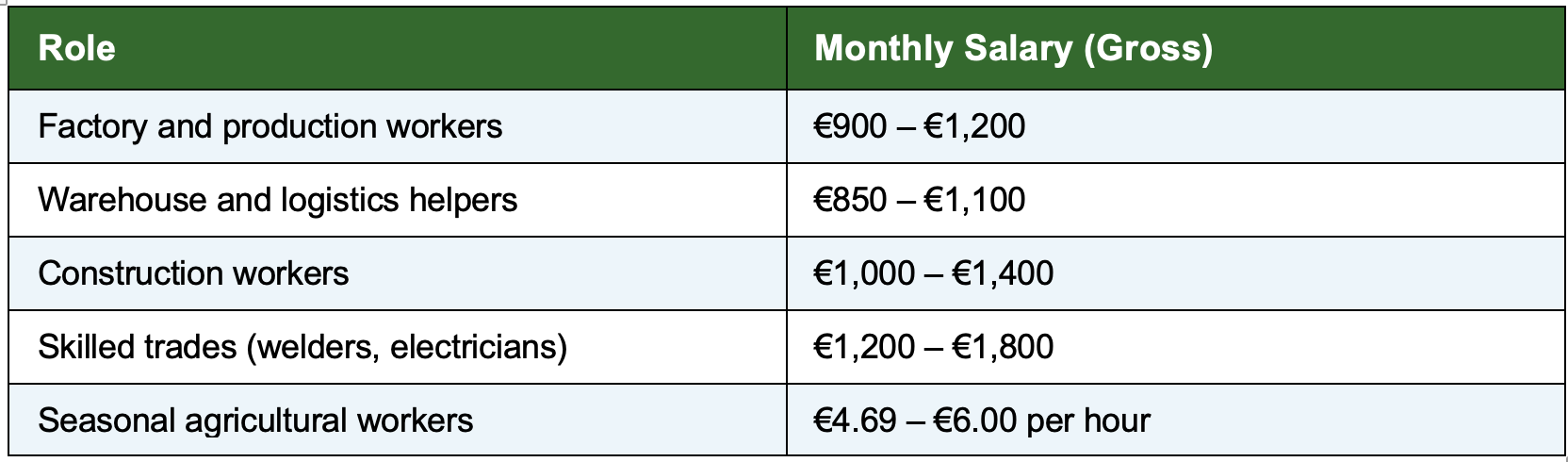
Important: These salaries are subject to Slovak income tax and social contributions. Your take-home will be lower than the gross figure. Most employers in Slovakia provide accommodation or a housing allowance, which reduces your living costs significantly.
Compared to Western Europe, Slovakia offers affordable housing and low living costs, enabling foreign workers to save a substantial portion of their earnings.
4. The Visa and Work Permit Process: Step by Step Guide
This is the most important section for any candidate planning to work in Slovakia. The process is employer-led — meaning your employer in Slovakia starts the process on your behalf.
Step 1 — Secure a confirmed job offer
You must have a signed employment contract or confirmed job offer from a registered Slovak employer before anything else can begin.
Step 2 — Employer submits work permit application
The employer must first report the job opening to the Labour Office, providing an opportunity for the Labour Office to find an eligible Slovak or EU citizen to fill the position. After 15 business days, the work permit application process can move forward.
Step 3 — Work permit is processed
The application for a work permit will be processed within 20 working days. If the worker obtained a seasonal work permit in the last five years, the Labour Office will grant a work permit within 10 working days from the date of submitting a complete application.
Step 4 — Apply for national visa at Slovak consulate
Once the work permit is approved, you apply for a Type D national visa at the Slovak embassy or consulate in your home country.
Step 5 — Arrive and register
On arrival in Slovakia, you register with the local Foreigners’ Police Department and begin work.
Realistic total timeline: 4 to 10 weeks 👉 IOM Slovakia work permit guide: www.mic.iom.sk
5. How Max International Supports Employers Hiring South Asian Workers for Slovakia
For employers in Slovakia looking to hire verified workers from India, Bangladesh, Nepal, or Sri Lanka — Max International handles the full recruitment process from a single point of contact.
We source directly from South Asia with no sub-agents. Every worker goes through our verification process before departure:
Background and identity verification
Skills assessment for trade-specific role
Medical clearance and police verification before travel
Full documentation and visa support — handled end to end
Whether you need production line workers, warehouse staff, or skilled tradesmen — we match candidates to your specific requirements and timeline.
👉 Talk to our Team today
Frequently Asked Questions
Q: Can workers from India, Bangladesh, and Nepal apply for jobs in Slovakia?
Yes. Slovak employers actively recruit workers from India, Nepal, and Bangladesh across factory work, logistics, hospitality, and agriculture. You need a confirmed job offer from a Slovak employer before the work permit process can begin. Max International can support the entire process.
Q: How long does the Slovakia work permit take to process?
Most applications take 4 to 10 weeks depending on the migration office’s workload. Seasonal work permits can be processed faster — within 10 working days in some cases.
Q: Do I need to speak Slovak to work in Slovakia?
For most factory, warehouse, and production roles — English is sufficient. Learning basic Slovak will improve your day-to-day experience significantly, but it is not always a strict requirement for blue-collar roles.
Q: How long can I stay in Slovakia on a work permit?
Work permits can be issued for up to 2 years and can be renewed. Seasonal work permits are limited to 90 days per calendar year.
Q: Can we hire workers from multiple South Asian countries for the same project?
Yes, and this is one of Max International's key advantages. Rather than managing separate agencies for Indian, Bangladeshi, and Nepali workers, we source across all South Asian nationalities through a single point of contact. You get the right fit for each role without the complexity of managing multiple recruitment partners.
Q: What happens if a worker's performance does not meet expectations after arrival?
Slovakia's Labour Code sets clear termination procedures. The decision must be communicated to the employee in writing and a minimum notice period of one month applies. Max International maintains accountability for the workers we place. If a worker does not meet your requirements, we work with you to find a resolution. This is why our pre-departure trade testing process matters — it significantly reduces the risk of workers arriving unprepared.
Q: How does Max International verify workers before they arrive in Slovakia?
Every worker Max International places goes through a structured pre-departure process — background and identity verification, hands-on skills assessment at our testing centres in India, medical clearance, and full documentation support. Workers arrive with verified credentials, not just CVs. This is particularly important for Slovak employers who need site-ready workers from day one.