Facility Management Staffing in Saudi Arabia: How South Asian Workers Are Powering Vision 2030
1. Saudi Arabia's FM Sector Is Growing Faster Than Most People Realise
When most people think about Vision 2030, they think cranes and construction. But behind every finished building — every hotel, hospital, mall, and giga-project — is a facility management operation that keeps it running.
The numbers tell the story clearly:
Saudi Arabia's FM market was valued at $26 billion in 2024 and is projected to reach $38.7 billion by 2030 (Source: Markntel Advisors)
A joint PwC and Saudi Facility Management Association report projects the sector to exceed $50 billion, growing at 7% annually through 2032
Outsourced FM services account for 61% of the market, meaning most of this work goes to specialist FM companies, not in-house teams
Every one of those buildings needs cleaners, security guards, housekeeping staff, maintenance technicians, and support workers. The demand is rising.
2. The Workforce Behind the Buildings: Why Nationality Matters in FM
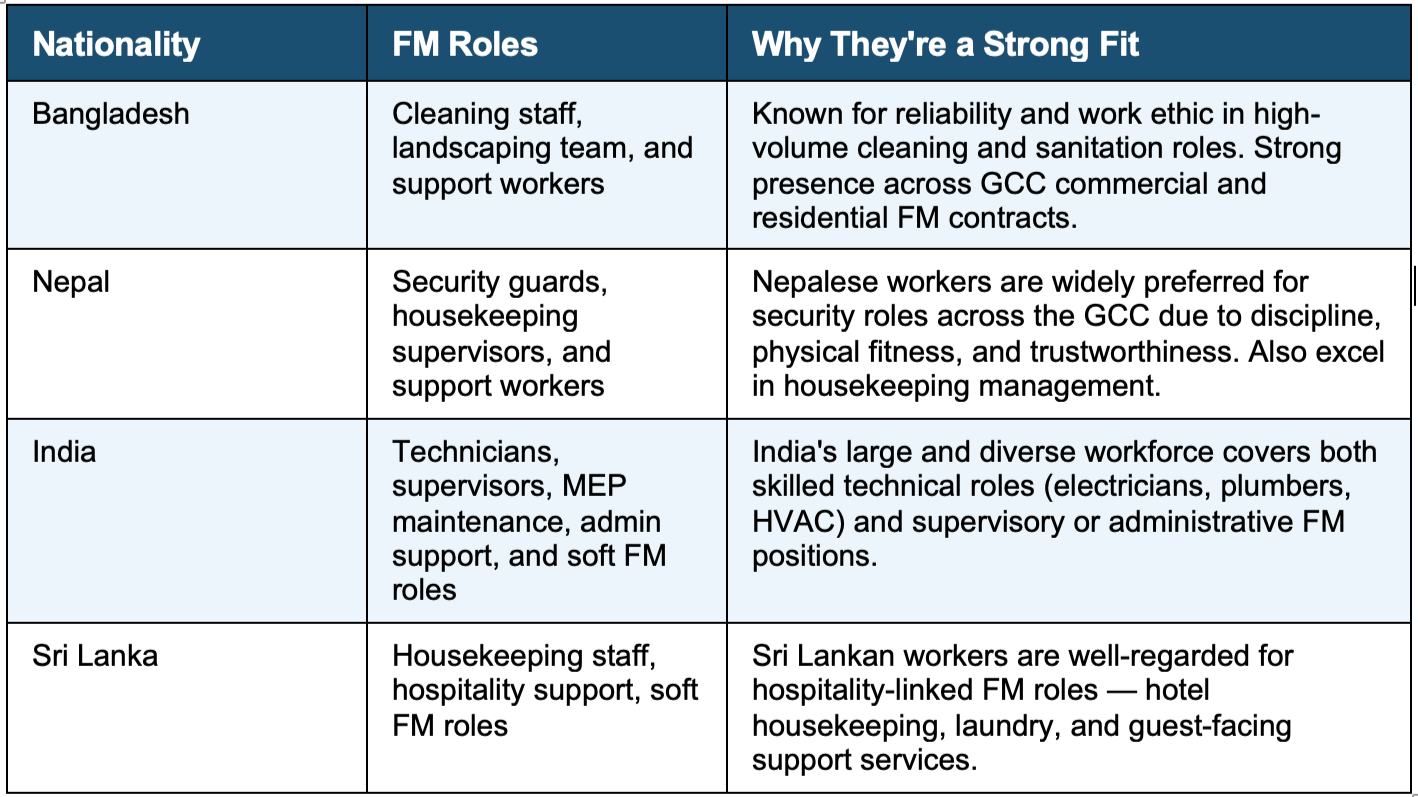
Here is something that experienced FM operators in the GCC already know but rarely talk about openly: different roles are best filled by workers from different countries — and it is not random. It comes from decades of placement experience, employer feedback, and on-the-ground performance.
Foreign workers make up 77% of Saudi Arabia's total workforce. In the FM sector, that number is even higher. Understanding where to source the right people for each role is one of the most practical advantages a recruitment partner can offer.
3. The FM Roles Most in Demand Across Saudi Arabia Right Now
Based on what FM companies across the Kingdom are actively sourcing, these are the roles seeing the highest demand in 2026:
Cleaning and sanitation staff for commercial towers, malls, and hospitality venues
Security guards for giga-project sites, residential compounds, and corporate facilities
Housekeeping teams for hotels and serviced apartments — tourism targets under Vision 2030 require 150 million visitors annually by 2030, up from 27 million in 2023
MEP maintenance technicians for ongoing building operations
Soft FM supervisors who can manage mixed-nationality teams on large contracts
4. The Gap FM Companies Are Struggling to Fill
The challenge is not finding workers in South Asia — there is no shortage of willing, capable candidates. The challenge is finding a recruitment partner who can:
Source the right nationality for each specific role
Verify workers properly before they travel
Handle visa, medical clearance, and documentation without delays
Mobilise workers in bulk when FM contracts require fast deployment
5. How Max International Fills That Gap
Max International has been placing South Asian workers across the GCC for over 20 years. For FM companies in Saudi Arabia, we offer something most recruitment agencies cannot — a single partner who sources across India, Bangladesh, Nepal, and Sri Lanka, with in-house testing facilities and end-to-end documentation support.
What this means in practice:
You tell us your FM contract requirements — roles, volumes, nationalities preferred
We match candidates from the right source country for each role type
Every worker is vetted, medically cleared, and document-ready before departure
We manage the full process — from sourcing to visa to flight booking
We are licensed by the Ministry of External Affairs, Government of India, and the Department of Economic Development, Government of Dubai — ISO 9001:2015 certified, and established since 2005. 👉Get in touch with the Max International team today
Frequently Asked Questions
Q: How do I hire facility management workers from South Asia for a Saudi Arabia project?
Start by identifying your role requirements — cleaning staff, security guards, housekeeping, or maintenance technicians along with volumes and your project start date. A licensed recruitment agency like Max International then sources, verifies, and mobilises the right workers from India, Bangladesh, Nepal, or Sri Lanka. We handle visa processing, medical clearance, and documentation end to end. The process typically takes 4 to 8 weeks from job order to workers arriving on site.
Q: How does Saudi Arabia's Nitaqat programme affect hiring overseas FM workers?
Saudi Arabia's Nitaqat programme requires companies to meet specific quotas for Saudi nationals. In 2026 these requirements are stricter than ever, with fines and visa restrictions for non-compliant companies. FM companies need to plan their workforce structure carefully. A compliant recruitment partner will help you maintain the right ratio of local to overseas workers so your block visa access is not affected.
Q: What documents does an FM company need before starting overseas recruitment in Saudi Arabia?
Before recruiting you will need a valid Saudi trade licence, a block visa or demand letter from the Ministry of Human Resources, and an employment contract template approved for the destination country. Max International guides employers through each of these requirements from the first conversation.
Q: Which nationalities are best suited for FM roles in Saudi Arabia?
This depends on the specific role. Bangladeshi workers are widely preferred for cleaning and sanitation roles due to their reliability in high-volume contracts. Nepalese workers are a strong choice for security guard positions. Indian workers cover technical maintenance and supervisory roles. Sri Lankan workers are well regarded for hospitality-linked housekeeping. Working with an agency that recruits across all four source countries means you get the right fit for each role rather than a one-size-fits-all approach.
Q: How quickly can FM workers be mobilised for a large Saudi contract?
With 45 to 75% of GCC employers currently struggling to find qualified talent and speed of mobilisation matters more than ever. With documents prepared and a clear job brief, Max International typically mobilises verified FM workers within 4 to 8 weeks. Bulk orders for cleaning or general support staff often move faster than technical roles due to the larger available candidate pool.
Q: Is outsourced FM recruitment cost-effective compared to hiring directly?
Yes, and the savings go beyond the recruitment fee. When you work with a specialist agency, you avoid the hidden costs of sourcing workers who are not trade-tested, replacing workers who leave early, and managing visa and documentation delays yourself. GCC Wage Protection Systems now mandate electronic salary transfers and introduce new social security requirements, raising total expatriate labour costs by an estimated 15 to 20% making it more important than ever to get the right workers the first time.
Q: What is the difference between hard FM and soft FM — and where does South Asian recruitment fit?
Hard FM covers technical services like MEP maintenance, HVAC, and electrical work. Soft FM covers non-technical services like cleaning, security, housekeeping, and landscaping. South Asian workers fill both categories well. Indian workers with ITI or polytechnic training are strong for hard FM roles. Bangladeshi, Nepalese, and Sri Lankan workers are consistently preferred across soft FM roles across Saudi Arabia and the UAE.
Q: How is Vision 2030 affecting demand for FM workers specifically?
Vision 2030 is creating enormous demand for FM workers beyond just construction. Saudi Arabia's focus on Vision 2030 megaprojects continues driving demand in construction, technology, and hospitality sectors, and every completed building, hotel, and commercial space needs an ongoing FM team to operate it. Saudi Arabia's tourism target of 150 million visitors annually by 2030 alone means thousands of new housekeeping, cleaning, and hospitality support roles opening every year.