Indian Workers in Israel: Roles, Salaries and How to Get There the Right Way
1. The India-Israel Labour Relationship - What It Means in 2026
India and Israel have had strong bilateral ties for decades. But in 2023, that relationship took a significant step forward for the labour market. In May 2023, the two governments signed a Framework Agreement on Temporary Employment of Indian Workers in Israel. This was followed in November 2023 by a Government-to-Government (G2G) framework, operated through India’s National Skill Development Corporation (NSDC), under the Ministry of Skill Development and Entrepreneurship.
The numbers since then speak clearly. Between November 2023 and July 2025, more than 20,000 Indian workers moved to Israel — confirmed by a statement made by the Indian Minister of State for External Affairs to Parliament in August 2025. Bilateral trade between the two countries stood at $3.9 billion in 2024, and in September 2025, India and Israel signed an additional bilateral investment agreement to further deepen economic cooperation.
Israel has formally targeted 100,000 Indian workers across construction and caregiving. The demand is documented, the framework is legal, and the pathway is open (Official website: Embassy of India, Israel)
2. Roles Most in Demand for Indian Workers in Israel
Israel’s construction sector has the highest and most documented demand for Indian workers right now. Israel’s Population and Immigration Authority (PIBA) formally requested the following four roles from NSDC India:

Beyond these four core trades, Indian workers are also placed in caregiving and elderly care, agriculture, and general construction support roles like civil and mechanical trades. Skill testing for construction roles is conducted by Israeli examiners who travel to India, or through approved Indian Recruitment Agencies (IRAs) registered with NSDC International.
3. What Indian Workers Earn in Israel: Salary Comparison
This is the section most candidates want to see. Here is an honest, verified comparison between what the same roles earn in India and what they earn in Israel. Israel’s minimum wage as of April 2025 is NIS 6,248 per month, approximately ₹1,40,000. This applies to all workers regardless of nationality. Source: Israel Ministry of Economy, April 2025.
Formwork / Shuttering: NIS 8,000–10,560/month (₹1,80,000–2,37,000 approx); India: ₹20,000–30,000.
Iron Bending: NIS 8,000–10,000/month (₹1,80,000–2,25,000 approx); India: ₹18,000–28,000.
Plastering: NIS 6,248–8,000/month (₹1,40,000–1,80,000 approx); India: ₹15,000–25,000.
Ceramic Tiling: NIS 6,248–8,000/month (₹1,40,000–1,80,000 approx); India: ₹14,000–22,000.
Caregiver: NIS 6,248–8,000/month (₹1,40,000–1,80,000 approx); India: ₹18,000–30,000.
What this means in practice: Indian workers in Israel typically earn five to eight times more than they would for the same work at home. This is why demand from candidates at recruitment drives has been overwhelming since 2024.
Important: Israeli salaries are subject to local income tax and deductions — unlike the Gulf where earnings are tax-free. Your take-home will be lower than the gross figure. Employers are also legally permitted to deduct limited amounts for housing and medical insurance from the gross salary.
4. The B2B Pathway: Why It Works and Why It Is the Right Route
There are two official routes for Indian workers to reach Israel — the Government-to-Government (G2G) channel managed by NSDC, and the Business-to-Business (B2B) channel through MEA-licensed Indian Recruitment Agencies working directly with Israeli employers.
Max International operates through the B2B route, and here is why this works better for most employers and candidates.
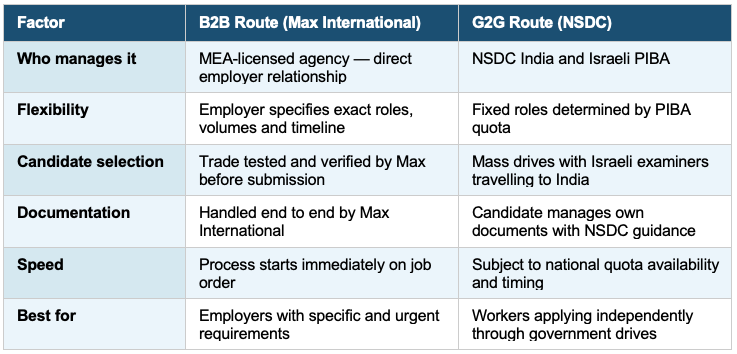
The B2B route gives employers direct control over who they hire, when the process starts, and what skills are prioritised. For Israeli construction and project companies working to deadlines, this matters significantly.
5. The Visa and Work Permit Process — Step by Step
Every Indian worker going to Israel through the B2B route requires a B-1 Work Visa and a work permit. The process is employer-led, meaning the Israeli company initiates the permit application. Here is how it works from start to finish.
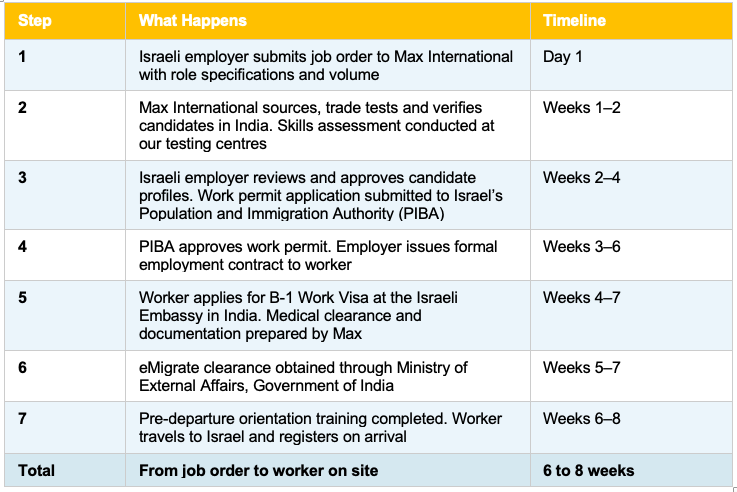
Plan early. The biggest delays come from employers who start the process late. If you have a project starting in four months — the conversation with Max should start now.
6. How Max International Supports Israel Companies
For Employers in Israel :
Israeli construction and project companies working through the B2B route can partner with Max International as their single recruitment point for Indian workers. Here is what we provide:
Role-specific sourcing — formwork, iron bending, plastering, tiling, caregiving and general construction
Trade testing before submission — workers are skills-verified at our testing centres in India before their profile is shared with you
Full documentation management — medical clearance, eMigrate, police clearance, visa support — handled end to end
Multi-trade capability — if your project needs a mix of trades or volumes, we build the team around your exact requirements
Single point of contact — no need to manage multiple agencies across different roles.
👉Verify Max International’s licence before applying — RA No. 0088/DEL/PER/1000+/5/7108/2005 on eMigrate Portal — emigrate.gov.in
👉 Talk to the MAX International Team or view Current Openings
Frequently Asked Questions
For Candidates
Q: Can Indian workers apply directly for jobs in Israel without going through an agency?
There are two legal routes. The G2G route is managed by NSDC India and is open to candidates who qualify through government recruitment drives. The B2B route goes through MEA-licensed recruitment agencies like Max International who work directly with Israeli employers. Both routes require a confirmed job offer and a B-1 Work Visa — no Indian worker can simply travel to Israel and seek work on arrival. Always verify any agency you approach on the official eMigrate portal at www.emigrate.gov.in before signing anything or paying any fee.
Q: What is the minimum salary I will receive working in Israel?
Israel's minimum wage as of April 2025 is NIS 6,248 per month — approximately ₹1,40,000. This is a legal minimum that applies to all workers regardless of nationality. Skilled construction roles such as formwork and iron bending typically earn between NIS 8,000 and NIS 10,560 per month. Your employer is legally permitted to deduct limited amounts for housing and medical insurance from this gross figure.
Q: Is my salary in Israel tax-free like Gulf countries?
No. Israeli salaries are subject to local income tax and social security deductions. Your take-home will be lower than the gross figure stated in your contract. That said, even after deductions, Israeli salaries remain significantly higher than equivalent roles in India — typically five to eight times more depending on the role.
Q: How long does the B-1 visa process take for Indian construction workers?
From the day an Israeli employer submits a job order to Max International, the realistic timeline to worker on site is 6 to 8 weeks. This includes trade testing and candidate verification in India, work permit submission and approval by Israel's Population and Immigration Authority, B-1 visa application at the Israeli Embassy in India, and eMigrate clearance through the Ministry of External Affairs.
Q: What documents do I need to prepare before applying?
You will need a valid passport with at least 6 months remaining, a Police Clearance Certificate from your state police or MEA India, a medical fitness certificate from an approved clinic, trade certificates or experience letters confirming your skills, and eMigrate clearance from the Ministry of External Affairs. Max International manages the coordination of all these documents so nothing is missed and the process runs in parallel.
Q: Can I change employers in Israel once I arrive?
Your B-1 Work Visa is tied to the specific Israeli employer who applied for your work permit. Changing employers requires a new work permit application. If your employer does not meet the terms of your contract, you have the right to raise a complaint. For welfare issues, contact the Indian Embassy in Israel directly at www.indembassyisrael.gov.in or use the MADAD grievance portal at madad.gov.in.
Q: How do I verify that a job offer from Israel is genuine?
Ask for the Israeli employer's company registration number and verify it on the Israeli company register. Ensure your recruitment agency is MEA-licensed — Max International's RA number is 0088/DEL/PER/1000+/5/7108/2005, verifiable at www.emigrate.gov.in. Never pay upfront fees for a job offer — a legitimate process does not ask workers to pay for their own placement.
For Employers
Q: How do Israeli construction companies hire Indian workers through the B2B route?
The process starts with the employer sharing their job requirements with Max International — roles, volumes, and project timeline. Max sources and trade-tests candidates in India, shares verified profiles for employer approval, and then manages the full documentation and permit process alongside the employer's work permit submission to PIBA. The employer initiates the work permit application in Israel while Max prepares candidates in India simultaneously — keeping the total process to 6 to 8 weeks.
Q: What is the difference between the G2G and B2B routes for Israeli employers?
The G2G route is managed by NSDC India and Israel's PIBA. It is subject to national quotas and fixed role categories and works through government-organised recruitment drives. The B2B route gives employers direct control — you specify the exact roles, volumes, and start dates, and the process begins immediately on your job order rather than waiting for quota availability. Max International operates through the B2B route.
Q: Can Max International supply multiple trades for a single construction project?
Yes. Max International sources from India across all construction trades — formwork, iron bending, plastering, ceramic tiling, MEP support, and general construction labour. If your project requires a mix of trades or different volumes across phases, we build the team around your exact requirements through a single point of contact. We also recruit from Bangladesh, Nepal, and Sri Lanka if the project requires a multi-nationality workforce.
Q: What verification does Max International do before sending workers to Israel?
Every candidate goes through a structured pre-departure process — background and identity verification, hands-on skills assessment at Max's testing centres in India, medical clearance, and full documentation review. Workers arrive in Israel with verified credentials, not just CVs. This significantly reduces the risk of skill mismatches or documentation issues on site.
Q: What is Max International's licensing and how do I verify it?
Max International is licensed by the Ministry of External Affairs, Government of India — RA No. 0088/DEL/PER/1000+/5/7108/2005 — and the Department of Economic Development, Government of Dubai. ISO 9001:2015 certified. Established since 2005. You can verify the MEA licence directly on the official eMigrate portal at www.emigrate.gov.in.