Hiring Nepali Workers for EU Projects in 2026: What Employers in Romania and Croatia Need to Know
1. The Nepal–Europe Labour Shift — What the Numbers Show in 2026
Five years ago, Europe barely registered as a destination for Nepali workers. That has changed quickly.
According to the Nepal Labour Migration Report 2024 (Ministry of Labour, Employment and Social Security), here is where things stand:
11,760 Nepalis received EU labour permits in 2017/18
55,117 received EU labour permits by end of 2024
34,366 permits were issued in just the first eight months of FY 2024/25, a 46 percent jump year on year
Romania alone saw a 136 percent increase in Nepali labour approvals in that same period
Official verification: EURES Labour Shortages Report 2024 — European Labour Authority
2. Roles Most in Demand for Nepali Workers in Europe
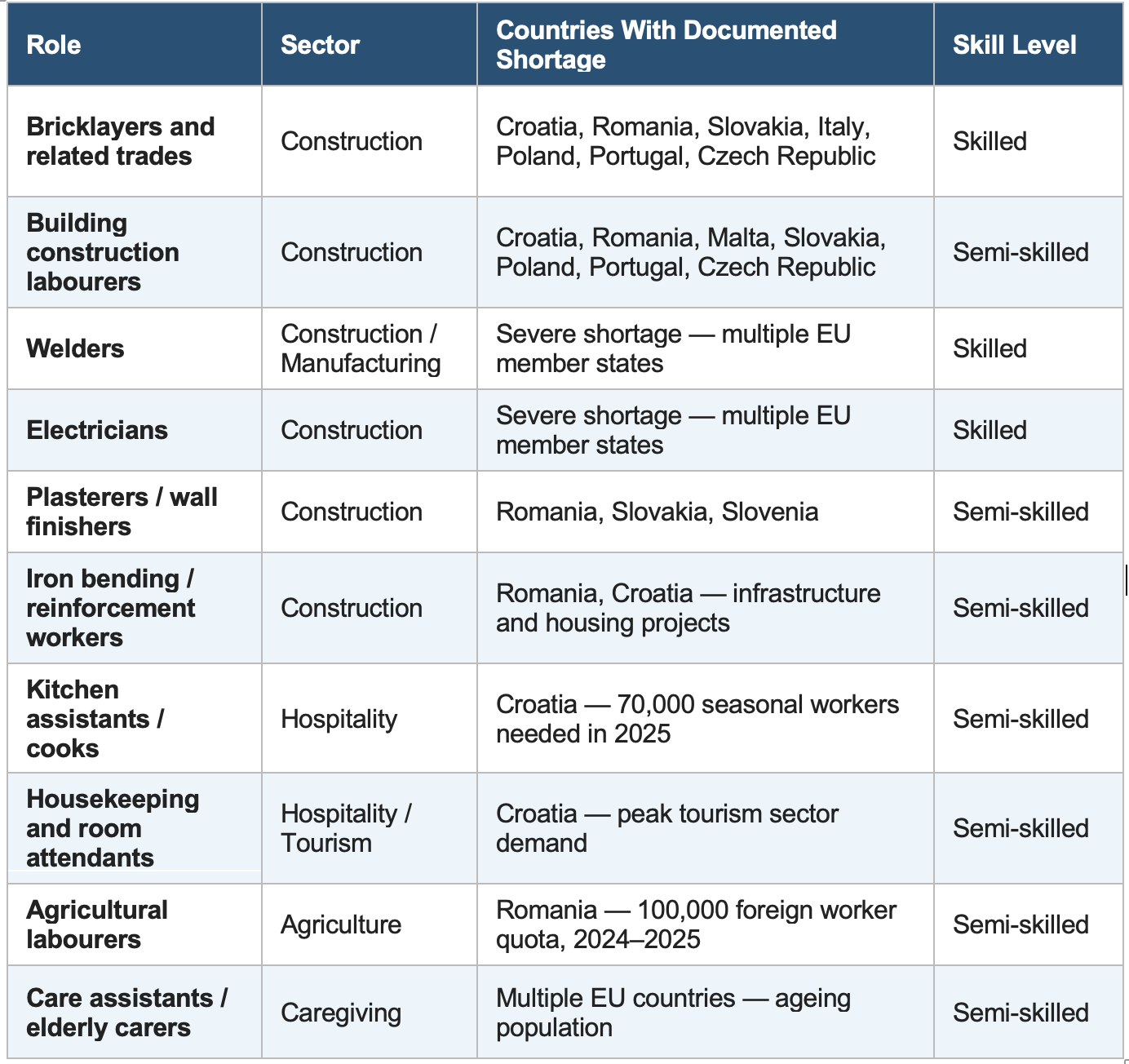
In Croatia alone, 75,000 construction work and residence permits were issued in 2025 — 36.3 percent of all permits issued that year. Nepal became the second-largest source of foreign workers in Croatia in early 2025, with 35,635 Nepali workers in active employment. Romania operated a 100,000 foreign worker quota in both 2024 and 2025, with construction and agriculture accounting for the majority of placements (World Bank — Enhancing Employment and Skills for Croatia's Growth, April 2025)
3. What Nepali Workers Earn in Europe — Salary Comparison
This is the section candidates want to see. As of 1 January 2026, official gross minimum wages are: Croatia — €1,050 per month (net approximately €800); Romania — €795 per month (net approximately €506), rising to €849 gross from July 2026. Exchange rate used: €1 = approximately NPR 173 (April 2026).
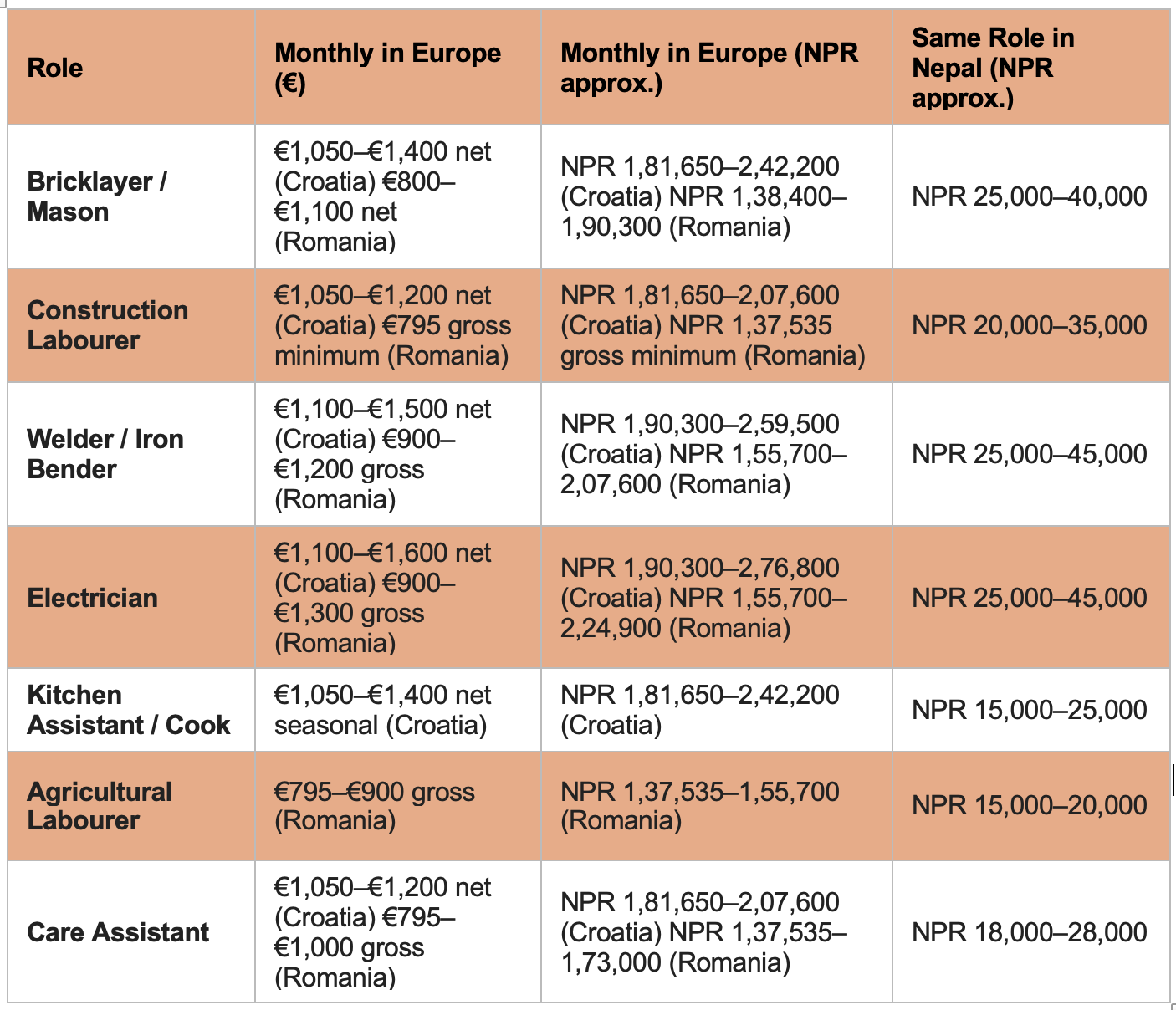
What this means in practice: Nepali workers in Europe typically earn four to six times more than they would for the same work at home.
Important: European salaries are subject to local income tax and social security contributions. Your take-home will be lower than the gross figure in your contract. In Romania, the gross minimum of €795 translates to approximately €506 net (NPR 87,500) after deductions. In Croatia, the gross minimum of €1,050 translates to approximately €800 net (NPR 1,38,400). Employers may also provide or deduct for housing and meals depending on the contract terms (Eurostat — First 2026 Data on Minimum Wages, January 2026)
4. The Work Permit and Labour Approval Process — Step by Step
Every Nepali worker going to Europe through the institutional route requires DoFE labour approval from Nepal and a work and residence permit from the destination country. The process is employer-led on the European side and agency-managed on the Nepal side. Here is how it works from start to finish.
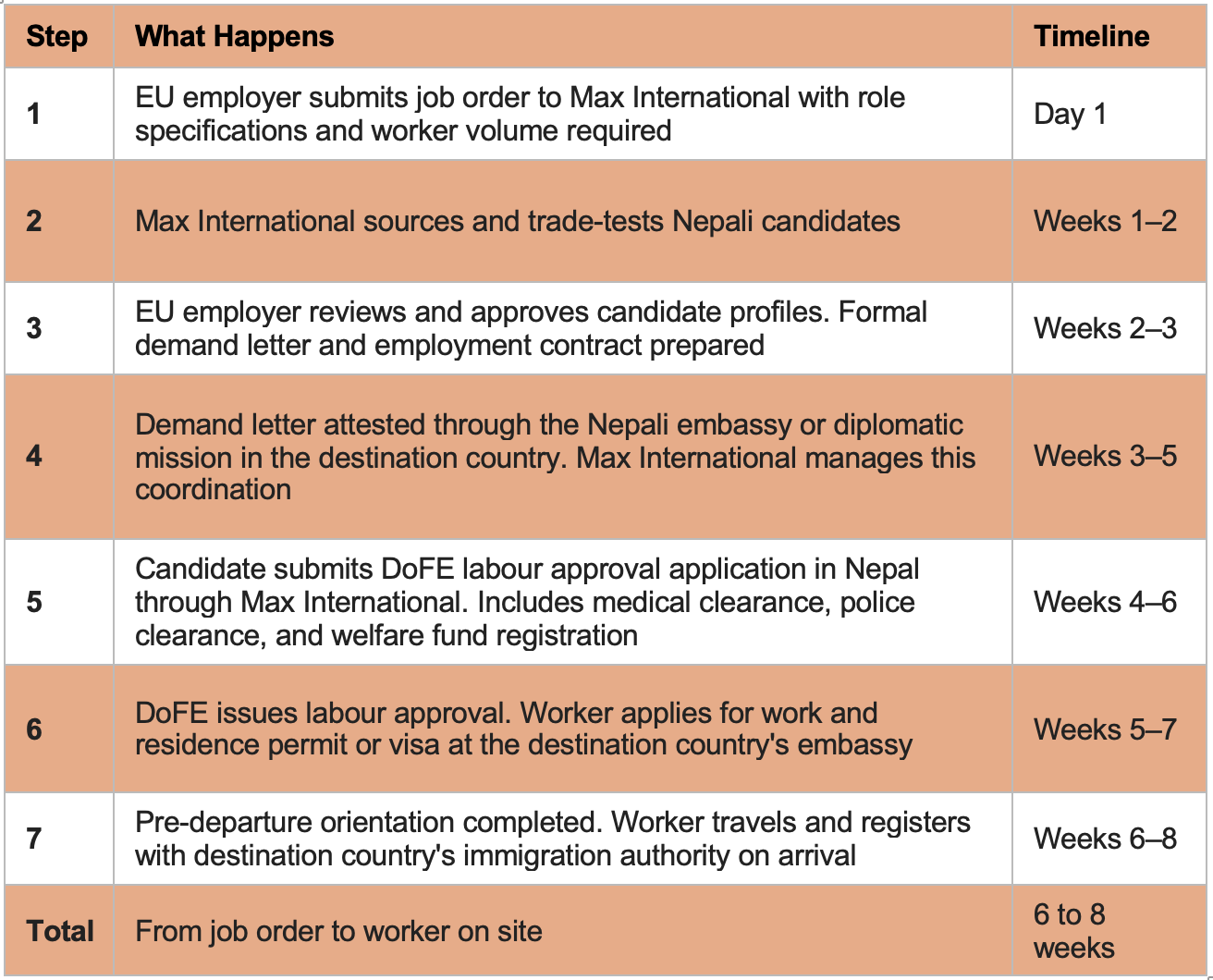
Plan early: The most common delay in the Europe process is demand letter attestation through the Nepali diplomatic mission in the destination country. If your project starts in three to four months, the conversation with Max should start now.
5. How Max International Supports European Employers
EU construction, hospitality, and agriculture companies hiring through the institutional route can partner with Max International as their single sourcing point for Nepali workers. Here is what we provide:
Role-specific sourcing: construction trades (bricklayers, labourers, welders, electricians, plasterers), hospitality support, agricultural labour, and caregiving
Trade testing before submission: workers are skills-verified at our testing centres before their profile is shared with you
Full documentation management: DoFE labour approval, medical clearance, police clearance, demand letter attestation, and visa support handled end to end
Multi-nationality capability: if your project needs Nepali workers alongside Indian, Bangladeshi, or Sri Lankan staff, we manage all sourcing through a single point of contact
Single point of contact: no need to coordinate multiple agencies across different roles or nationalities
👉Verify Max International’s licence before applying — RA No. 0088/DEL/PER/1000+/5/7108/2005 on eMigrate Portal — emigrate.gov.in
👉 Talk to the MAX International Team or view Current Openings
Frequently Asked Questions
For Candidates
Q: Can Nepali workers go to Europe independently, or do they need an agency?
There are two legal routes. The individual permit route allows workers to secure employment independently. The institutional route goes through a DoFE-licensed agency like Max International, which works directly with verified EU employers. The institutional route provides full documentation support, employer verification, welfare fund coverage, and a formal process if anything goes wrong. The DoFE's complaints branch received over 2,000 individual permit complaints in a five-month period alone — the institutional route exists to protect workers from this. Always verify any agency you use on the official DoFE portal at dofe.gov.np before signing anything or paying any fee.
Q: What is the minimum salary I will receive working in Europe?
This depends on the destination country. As of January 2026, the gross minimum wage in Croatia is €1,050 per month (approximately NPR 1,81,650; net approximately NPR 1,38,400) and in Romania is €795 per month (approximately NPR 1,37,535; net approximately NPR 87,500), rising to €849 gross from July 2026. Skilled construction roles typically earn above minimum — bricklayers and welders in Croatia can earn €1,100–€1,500 net per month (NPR 1,90,300–2,59,500). Your contract must clearly state both the gross and net figures. Source: Eurostat, January 2026.
Q: Is my salary in Europe tax-free like Gulf countries?
No. European salaries are subject to local income tax and social security contributions. Your take-home will be lower than the gross figure stated in your contract. That said, even after deductions, European salaries are significantly higher than equivalent roles in Nepal — typically four to six times more depending on the role and country.
Q: How long does the full process take from application to arriving in Europe?
End to end — from job order confirmation to the worker being on site — typically 6 to 8 weeks when documentation is in order and employer verification is complete. The most time-consuming stage is demand letter attestation through the Nepali diplomatic mission in the destination country. Max International manages this coordination.
Q: What documents do I need to prepare before applying?
You will need: a valid passport with at least 6 months remaining, a Police Clearance Certificate, a medical fitness certificate from a DoFE-approved centre, trade certificates or experience letters for your role, and DoFE labour approval through the agency. You will also need to register with the Foreign Employment Board welfare fund before departure. Max International coordinates all of this so nothing is missed and documents are processed in parallel.
Q: Which countries in Europe are most active for Nepali workers right now?
Romania and Croatia have the highest documented volumes and most active recruitment pipelines in 2024–2025. Romania issued a 100,000 foreign worker quota for both 2024 and 2025. Croatia issued more construction work permits per capita than any other EU country in 2025 and Nepal became its second-largest source of foreign workers in early 2025. Cyprus, Malta, Slovakia, and Poland also have documented shortages across construction and hospitality.
For Employers
Q: What roles can Max International supply from Nepal?
For EU construction and infrastructure projects: bricklayers, building labourers, iron benders, plasterers, welders, and electricians. For hospitality and tourism: housekeeping staff, kitchen assistants, and waitstaff. For agriculture: seasonal labourers and farm support workers. For caregiving: care assistants and elderly care workers. If your project needs a mix of roles or nationalities, we build the team around your exact specifications.
Q: What does the employer need to provide to start the recruitment process?
To begin recruiting Nepali workers for an EU project, you will need a valid business registration, a formal demand letter or job offer with role specifications and salary details, and a signed employment contract template. The demand letter must be attested by the Nepali diplomatic mission in your country. Max International guides employers through this step and manages the attestation process.
Q: How does the institutional route compare to workers arriving independently?
The institutional route gives EU employers direct control over candidate selection, trade testing, timelines, and volumes. Workers arrive with verified credentials, DoFE clearance, and a formal employment contract. For employers who need to meet project deadlines and manage compliance under EU labour law, the institutional route is substantially lower risk than hiring workers who arrived on individual permits.
Q: Can Max International supply workers from Nepal and other South Asian countries for the same project?
Yes. Max International recruits from Nepal, India, Bangladesh, and Sri Lanka. If your project requires Nepali construction labourers alongside Indian skilled tradespeople, we manage all sourcing through a single point of contact with a unified documentation and mobilisation process.
Q: Are Nepali workers covered by European labour law once in the country?
Yes. Once on a valid work and residence permit in an EU country, Nepali workers are covered by the full labour law protections of that country — including minimum wage legislation, working hour limits, social security contributions, and workplace health and safety regulations. Foreign workers cannot legally be paid below the national minimum wage. Max International verifies all employment contracts for compliance before any worker travels.