Hiring Construction, Oil and Gas and Facility Management Workers from South Asia for Singapore Projects: A 2026 Guide for Employers and Recruitment Agencies
1. Singapore's Construction Demand and the South Asian Workforce
Singapore's built environment sector is in active delivery mode. The Building and Construction Authority (BCA) projected total construction demand at S$47 billion to S$53 billion for 2026, supported by major public infrastructure programs including Changi Airport Terminal 5, public housing development, and MRT network expansion. That volume of work needs people. Singapore’s resident workforce cannot fill the trades gap in construction, oil and gas, and facility management at the scale these projects require.
The Work Permit system, administered by the Ministry of Manpower (MOM) — exists to bridge that gap through structured, regulated recruitment from approved source countries. Three of those approved countries are India, Bangladesh, and Sri Lanka. Workers from all three can legally take up employment in Singapore's construction sector under MOM's Non-Traditional Source (NTS) classification. Official website: Ministry of Manpower Singapore — Work Permit for Foreign Workers
2. Approved Source Countries — What This Means for Employers
Singapore divides Work Permit source countries into categories by sector. For the construction sector, two categories apply:

India, Bangladesh, and Sri Lanka all fall under the NTS category. Singapore-registered employers in the construction, oil and gas, and facility management sectors can hire from all three countries subject to quota and levy requirements set by MOM.
3. Quota and Levy — The Numbers Employers Need to Know
Two tools control how many foreign workers a Singapore-registered company can hire and at what cost.
Dependency Ratio Ceiling (DRC)
The DRC sets the maximum ratio of Work Permit holders to the company's local workforce. In the construction sector, companies can hire up to seven Work Permit holders for every local employee — the highest DRC of any sector in Singapore.
From 1 July 2026, the Local Qualifying Salary (LQS) — the minimum monthly wage a local employee must earn to count toward the quota — rises from S$1,600 to S$1,800. Employers should review local payroll ahead of this date. Local workers earning below S$1,800 will no longer count toward the quota calculation, which reduces available space for foreign worker applications.
Foreign Worker Levy (FWL)
The levy is a monthly fee paid by the employer to the government for each Work Permit holder. It is not deducted from the worker's salary.

Workers qualify as Higher Skilled if they earn a fixed monthly salary of at least S$1,600 or have worked four or more years in Singapore. Employers with a higher ratio of foreign workers to locals pay more per worker — this is the DRC tier structure in practice.
4. Key 2026 Policy Updates
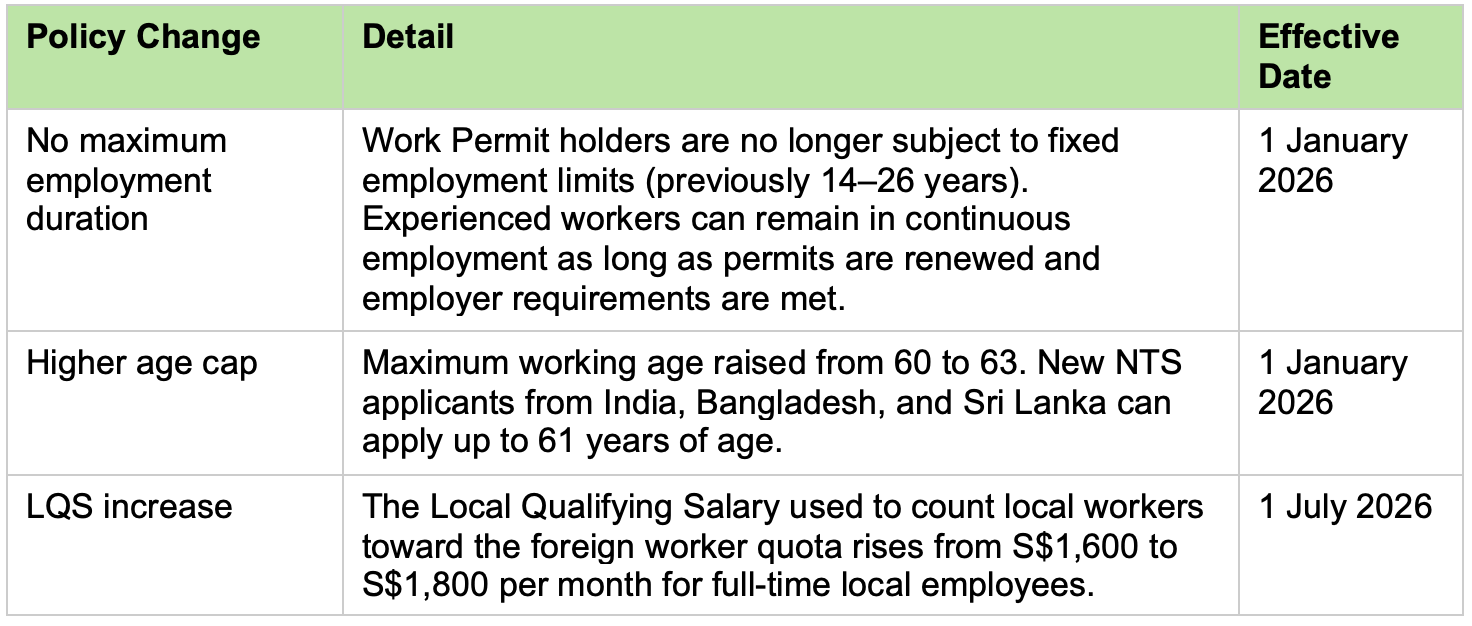
Check out the official website for up to date information: Budget 2026 Foreign Workforce Policy Announcements
5. Roles Max International Can Supply
Max International sources, verifies, and mobilises workers across three sectors for Singapore projects. All workers are skills-assessed at Max International's trade testing centres in India and Bangladesh before profiles are submitted. Sri Lanka candidates are assessed through verified field partners.
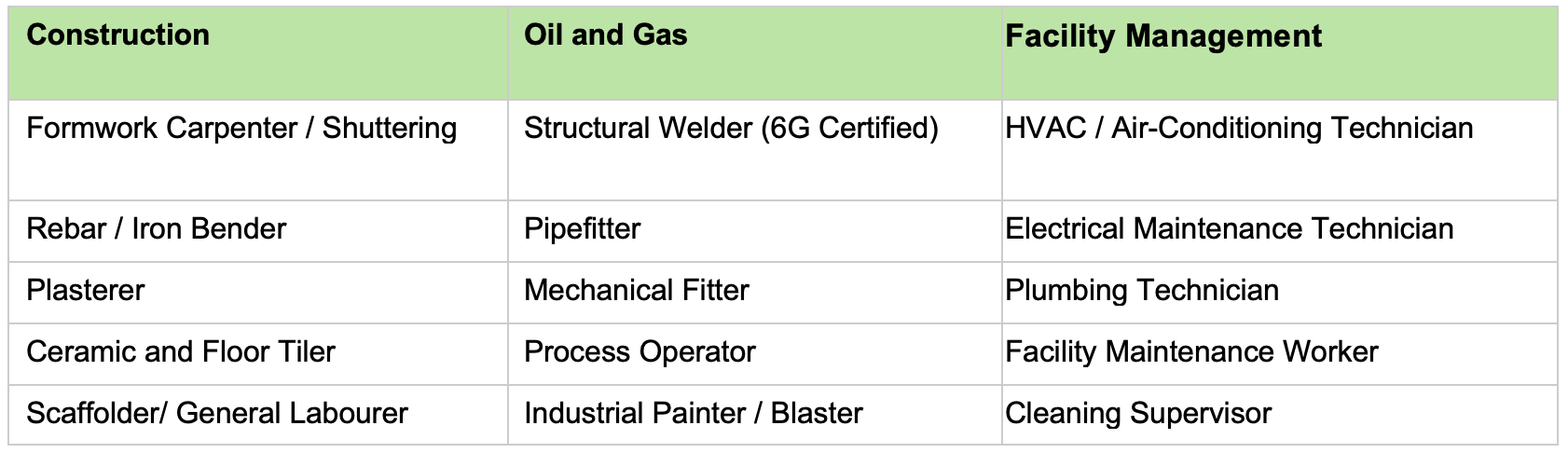
You can find list of industries we support for overseas companies on our website.
6. The Process — From Job Order to Worker on Site
Singapore Work Permits are employer-led. The Singapore-registered company initiates the application through MOM's WP Online portal. Here is how the full process works when an employer or agency partner works with Max International.
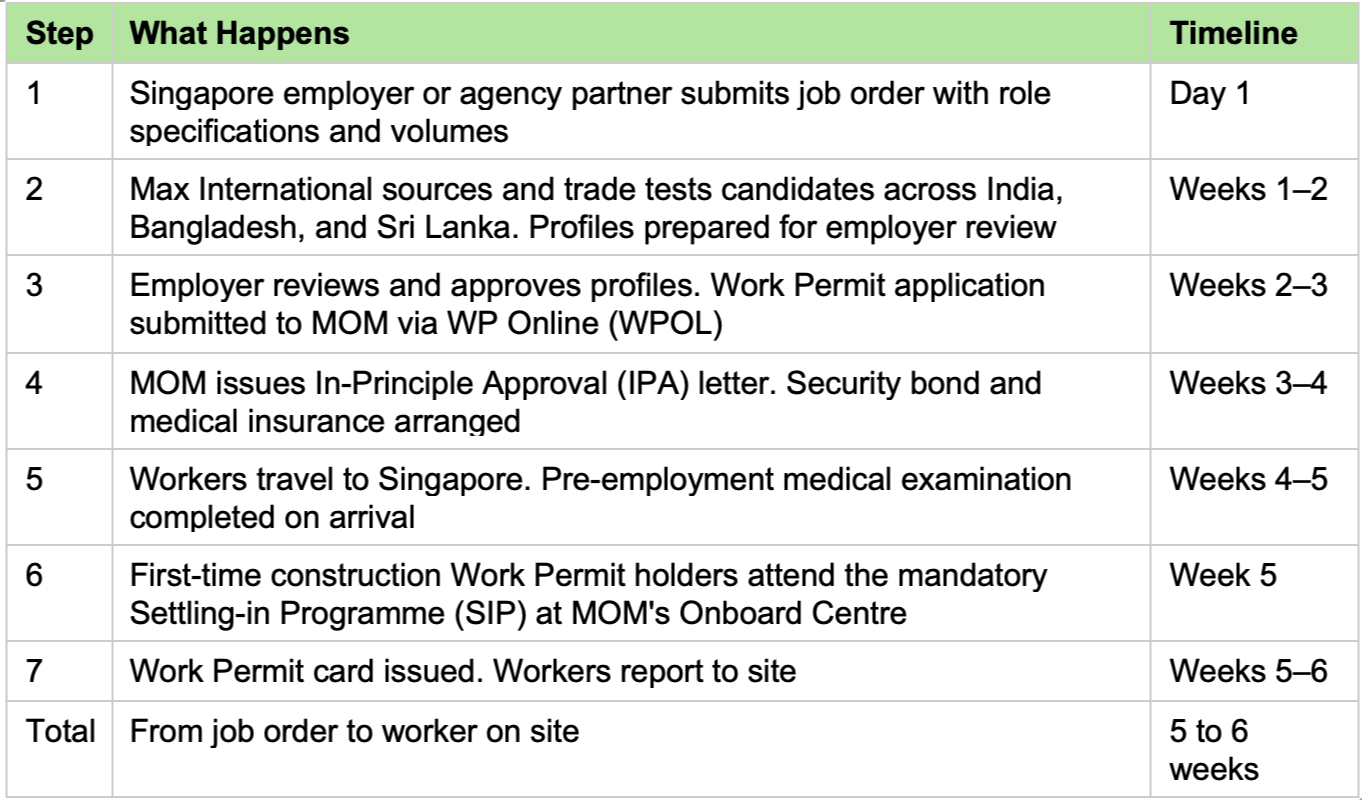
Note: Timelines are indicative. Actual mobilisation time may vary depending on MOM processing load, document completeness, and any additional requirements specific to the role or worker nationality. Max International will flag any expected delays at the earliest stage.
7. Working with Max International
For Singapore Employers
Construction, oil and gas, and facility management companies that need verified South Asian workers can work with Max International as a sourcing partner across India, Bangladesh, and Sri Lanka. Submit a job order and receive trade-tested, document-ready candidates — sourcing, skills verification, country-of-origin documentation, and mobilisation are managed at the Max International end.
For Singapore Recruitment Agencies
Agencies looking to add South Asian supply capability for their construction and facility management clients can work with Max International as a supply-side partner. We provide trade-tested candidates from verified networks across three MOM-approved NTS countries, working within your existing client relationships and compliance frameworks.
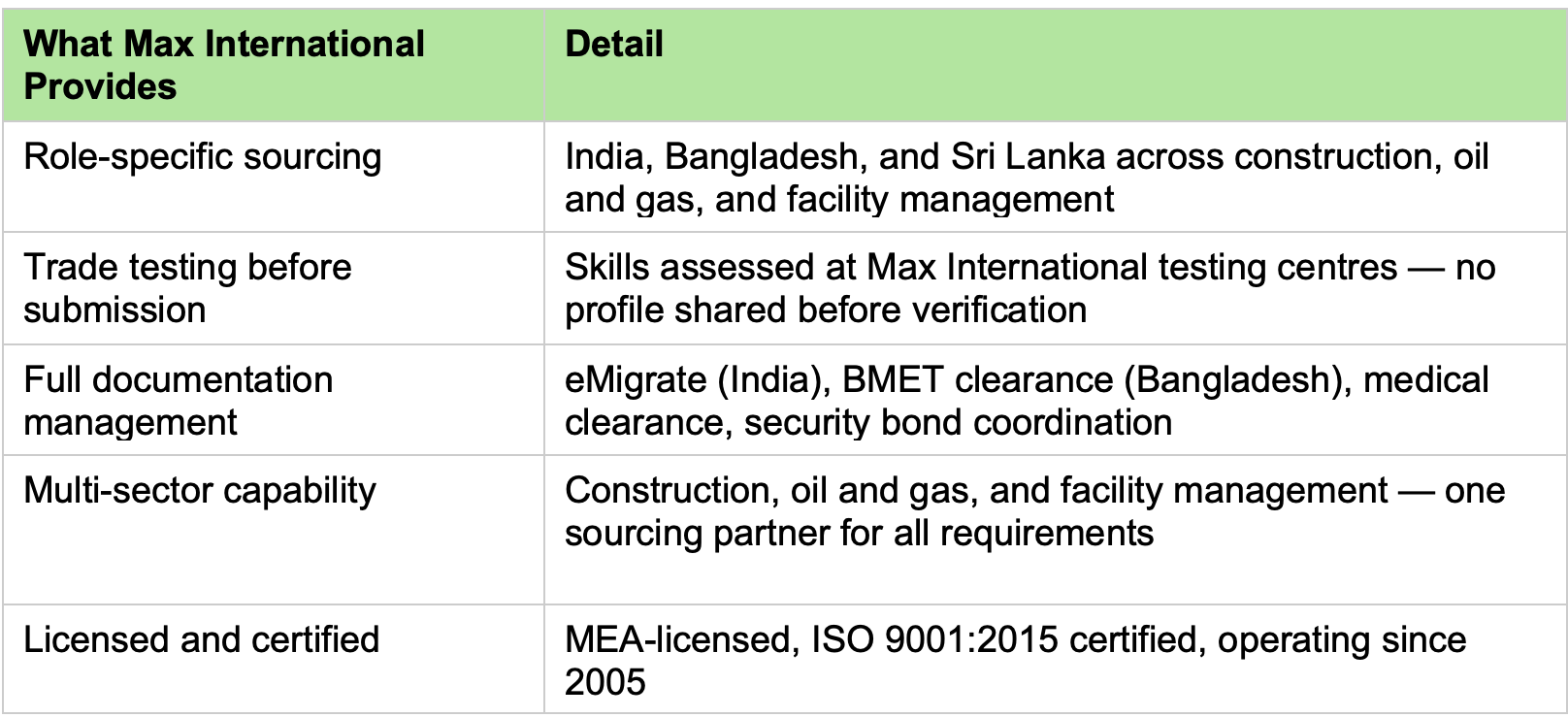
👉 Verify Max International’s licence before applying — RA No. 0088/DEL/PER/1000+/5/7108/2005 on eMigrate Portal — emigrate.gov.in or If you have any questions talk to our Max International Team
Frequently Asked Questions
Q: Can Indian, Bangladeshi, and Sri Lankan workers get Work Permits for Singapore construction?
Yes. India, Bangladesh, and Sri Lanka are listed as approved Non-Traditional Source (NTS) countries for Work Permits in Singapore's construction sector by the Ministry of Manpower (MOM). Employers must have the appropriate quota and pay the Foreign Worker Levy for each worker hired.
How many foreign workers can a Singapore construction company hire?
The Dependency Ratio Ceiling (DRC) for the construction sector allows up to seven Work Permit holders for every local employee on payroll — the highest ratio of any sector in Singapore.
How long does it take to get a construction worker from South Asia to Singapore?
From job order to worker on site typically takes 5 to 6 weeks, subject to MOM processing time, document completeness, and any sector-specific requirements. Delays in documentation or additional MOM checks can extend this timeline.
What levy does a Singapore employer pay for a construction Work Permit holder?
Levy rates for construction range from S$300 to S$950 per worker per month, depending on the worker's skill classification and the employer's dependency ratio tier. Higher-skilled workers (R1) attract the lower rate; basic-skilled workers (R2) attract the higher rate.
Has the maximum employment period for Work Permit holders been removed?
Yes. From 1 January 2026, MOM removed fixed maximum employment durations. Work Permit holders can continue in employment as long as permits are renewed and employer requirements are met — the previous limit was 14 to 26 years depending on sector and nationality.
What is the Local Qualifying Salary (LQS) and why does it matter for hiring?
The LQS is the minimum monthly wage a local employee must earn to count toward a company's foreign worker quota. From 1 July 2026, this rises from S$1,600 to S$1,800 per month. Employers whose local staff earn below this threshold will see their available quota for foreign workers reduce.
How does a Singapore recruitment agency collaborate with Max International?
Singapore agencies can work with Max International as a supply-side partner — we source, trade test, and prepare South Asian workers for your clients' projects. We operate within your existing client and MOM compliance framework. Contact the Max International team to discuss collaboration arrangements.