Hiring Foreign Worker in Malaysia, and How Max International Supports Both Direct Employers and Local Recruitment Agencies.
1. The Malaysian labour market in 2026
Malaysia's economy runs partly on foreign labour. Construction sites, manufacturing floors, plantation estates and service operations have all been built around a workforce mix of local employees and migrant workers from South and Southeast Asia.
The latest official figure, cited by the Deputy Human Resources Minister in Dewan Rakyat on 3 November 2025, places active legally registered foreign workers at 2,132,578 as of 15 October 2025. That is 13% lower than the same period in 2024, the result of government policy to reduce dependence on low-skilled foreign labour while preserving capacity in approved sectors.
Sector distribution as of October 2025:
Manufacturing: 622,388
Construction: 589,684
Services: 390,607
Plantation: 263,131
Agriculture: 158,628
Domestic helpers: 107,375
Mining and quarrying: 765
Under the 12th Malaysia Plan, foreign worker employment is capped at 15% of the national workforce. The 13th Malaysia Plan (2026-2030), approved by Parliament in August 2025, tightens this to 10% by 2030 with a 5% target by 2035. The Multi-Tier Levy Mechanism rolls out in 2026. (Ministry of Human Resources Malaysia (KESUMA)
Source country corridors most active in Malaysia: Indian, Nepal, Bangladesh, and Myanmar.
2. Roles in demand for South Asian workers
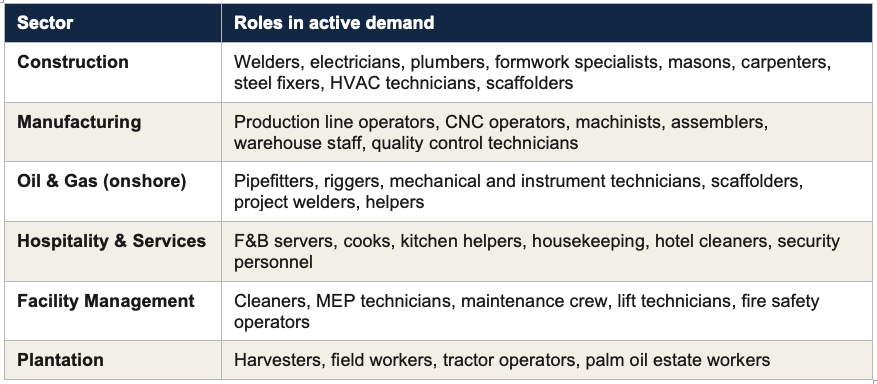
The table below covers verified high-demand roles across Malaysia's main hiring sectors.
3. What South Asian workers earn in Malaysia
The national minimum wage is set under the Minimum Wages Order 2024. From 1 August 2025, RM 1,700 per month is fully enforced for all employers, with only domestic helpers and apprentices exempt. This applies equally to Malaysian and foreign workers. RM 1,700 is the floor. Actual wages for trade-tested workers are typically higher and depend on sector, trade and experience.
Proper screening helps employers ensure that workers match the job requirements:
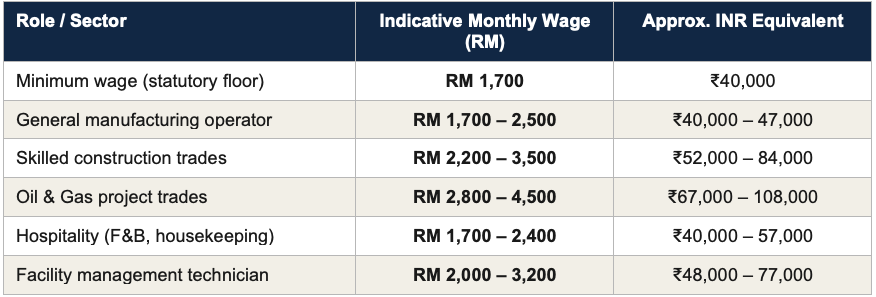
Indicative ranges based on DOSM formal sector wage data. Actual offers are negotiated between employer and worker and may include overtime, accommodation, transport and meal allowances.
A few practical points:
Standard working week is 8 hours/day and overtime is governed by the Employment Act 1955
Overtime: 1.5x for normal weekday extension
Employer contributions include SOCSO Employment Injury Scheme for all foreign workers and EIS where applicable. EPF rules for foreign workers should be verified with KWSP for current implementation
Many employers provide accommodation, transport and meals as part of the package
The minimum wage cannot be reduced by counting allowances or incentives. Basic salary must meet or exceed RM 1,700 (Ministry of Human Resources Malaysia (KESUMA)
4. Visa, work permit and the hiring timeline
Malaysia uses an employer-led work authorisation framework. Every foreign worker needs a Visa with Reference (VDR) issued by the Immigration Department, followed by a Visit Pass (Temporary Employment), VPTE, after arrival and FOMEMA medical clearance.
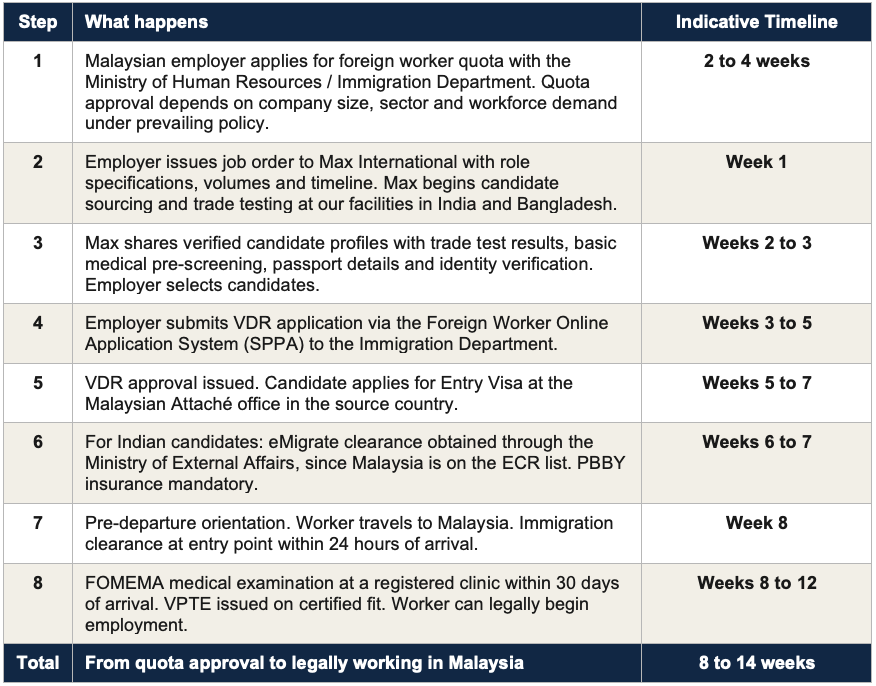
Important note: Indicative timelines are based on standard processing observed under normal conditions. Actual delivery can extend due to documentation delays, visa appointment availability at the Malaysian Attaché office, FOMEMA clinic backlogs or seasonal application volume. Max International does not promise or guarantee a fixed visa or permit issuance date. We commit to managing the source-country process efficiently and keeping all parties updated transparently.
Documents required from the candidate side:
Passport valid for at least 18 months from intended date of travel
Police clearance certificate (issued within last 6 months)
Medical fitness certificate from approved clinic in source country
Trade test certificate or experience letter
Employment contract signed by Malaysian employer
Passport-size photographs to Malaysian Immigration specification
For Indian workers: eMigrate clearance documentation and PBBY insurance proof
Documents required from the Malaysian employer side:
Quota approval letter from the Ministry of Human Resources / Immigration Department
Company registration documents (SSM)
Levy payment receipts
Approved SPPA submission
VDR application form
Employer-side documentation for FOMEMA registration
5. How Max International supports Malaysian employers and recruitment agencies
Max International works with the Malaysian market through two engagement models — direct partnerships with Malaysian employers, and B2B partnerships with local Malaysian recruitment agencies. Both routes are designed to give Malaysian businesses access to a verified, trade-tested South Asian workforce without managing multiple agencies across countries.
For Malaysian construction, manufacturing, hospitality, oil & gas and facility management companies (direct engagement)
If you are a Malaysian employer hiring directly without going through a local agency, Max International becomes your direct recruitment partner in South Asia. We work with your HR or project team to:
Define exact role specifications, volumes and project timeline
Source and trade-test candidates against your requirements at our facilities in India and Bangladesh
Share verified candidate profiles for your selection
Handle police verification, medical pre-screening and documentation in the source country
Coordinate eMigrate clearance for Indian candidates and BMET clearance for Bangladeshi candidates
Manage pre-departure orientation and departure logistics so workers arrive ready for FOMEMA and VPTE issuance
This route works best for Malaysian companies hiring at scale, with in-house HR or compliance teams familiar with VDR and FOMEMA processes.
For Malaysian recruitment agencies (B2B partnerships)
If you are a Malaysian recruitment agency placing workers into local construction, manufacturing, hospitality, oil and gas or facility management projects, partnering with Max gives you a structured pipeline from India, Bangladesh and Nepal.
Pre-tested candidates from our in-house trade testing centres in India and Bangladesh, ready to deploy after FOMEMA clearance
Volume hiring capacity across multiple trades simultaneously, useful when a single Malaysian project needs welders, electricians, formwork specialists and helpers together
Source-country documentation coordination — police clearance, medical, eMigrate (for Indian workers), BMET (for Bangladeshi workers) and trade certification handled in source country
Single-source recruitment rather than working with separate sub-agents in three or four South Asian countries
Compliance with both source-country and Malaysian frameworks including alignment with bilateral MoU terms where applicable
6. Our operational advantage
✍️ 20 years of experience placing workers across GCC, Southeast Asia and European markets
⚒️ In-house physical trade testing centres in India and on-site testing in Bangladesh
🤝 Active recruitment pipeline across India, Bangladesh, Nepal and Sri Lanka.
Talk to the Max International Team | View Current Openings
Frequently Asked Questions
Q1. Can Malaysian companies legally hire South Asian workers in 2026?
Yes. Malaysian employers in approved sectors including construction, manufacturing, plantation, agriculture and services can hire foreign workers from India, Bangladesh, Nepal and Sri Lanka. The process is governed by the Immigration Department of Malaysia under the Ministry of Home Affairs and requires foreign worker quota approval before recruitment can begin. Bilateral arrangements exist with Bangladesh under an MoU valid until December 2026.
Q2. What is the minimum wage in Malaysia for foreign workers in 2026?
The national minimum wage is RM 1,700 per month, fully enforced for all employers from 1 August 2025 under the Minimum Wages Order 2024. This applies equally to Malaysian citizens and foreign workers holding a Visit Pass (Temporary Employment). Domestic helpers and apprentices are exempt. Source: Ministry of Human Resources Malaysia (KESUMA).
Q3. How long does the Malaysia work visa process take?
The standard end-to-end timeline is approximately 8 to 14 weeks from quota approval to legally working in Malaysia. The VDR is typically issued within 2 to 4 weeks of submission. The Entry Visa is applied for at the Malaysian Attaché office in the source country. FOMEMA medical examination must be completed within 30 days of arrival, after which the VPTE is issued. Timelines may extend due to documentation delays, FOMEMA clinic capacity or visa appointment availability.
Q4. What is the difference between VDR and VPTE in Malaysia?
The Visa with Reference (VDR) is the pre-arrival authorisation issued by the Immigration Department of Malaysia to the employer for a named foreign worker. It allows the worker to apply for an Entry Visa at the Malaysian Attaché office in the source country. The Visit Pass (Temporary Employment), VPTE, is issued after the worker arrives in Malaysia and passes the FOMEMA medical examination. The VPTE is the legal authorisation to live and work in Malaysia and is initially valid for one to two years, renewable annually.
Q5. Does Max International work with Malaysian employers and recruitment agencies?
Yes. Max International works with the Malaysian market through two engagement models — direct partnerships with Malaysian employers hiring at scale across construction, manufacturing, hospitality, oil and gas and facility management, and B2B partnerships with local Malaysian recruitment agencies placing workers into specific projects. Max International is MEA-licensed in India (RA No. 0088/DEL/PER/1000+/5/7108/2005) and operates in-house trade testing centres in India and Bangladesh.