Indian Workers in Albania: Demand, Salaries, Visa Process and the B2B Hiring Route
1. The Albanian Labour Market in 2026 and why the Demand is Real
Albania has been losing workers for over a decade. According to INSTAT and State Labour Inspectorate data, more than 400,000 Albanians have emigrated in the past 13 years, with roughly 28,000 net departures every year. Most of them head to Germany, Italy and other EU countries for higher wages. The result is a labour market with genuine gaps. By mid-2025, around 13,000 foreign nationals held regular work permits in Albania, with the State Inspectorate reporting a 15 to 20% increase in foreign worker arrivals compared to 2024. The Albanian government has moved to amend its immigration law to attract more foreign labour, and is in active negotiation with the Philippines and Indonesia for larger workforce agreements.
The sectors driving this demand are clear:
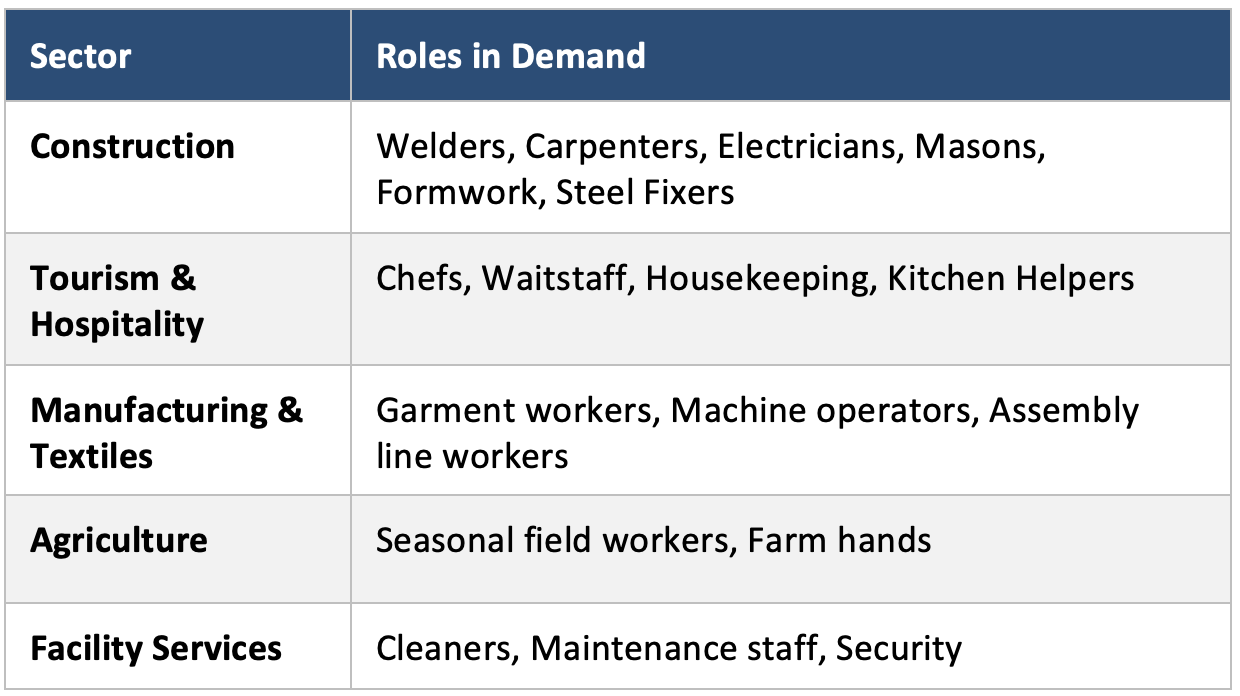
• Construction — welders, carpenters, electricians, masons, formwork specialists
• Tourism and hospitality — chefs, waitstaff, housekeeping, kitchen helpers, driven by Albania’s 11.7 million foreign visitor arrivals in 2024
• Manufacturing and textiles — particularly in garments and assembly
• Agriculture — seasonal field workers
Indian, Nepalese and Bangladeshi workers are now among the top source nationalities, alongside Filipinos and Egyptians.
Official website: Albanian Ministry of Interior
2. Roles Most in Demand for Indian and South Asian Workers
The table below covers the verified high-demand roles across Albania’s biggest hiring sectors.
Most positions are full-time, with contracts typically running 1 to 2 years and renewable. Tourism roles are often seasonal, running from April to October.
3. What Indian Workers Earn in Albania
Salary in Albania is set by national law, and 2026 has brought a meaningful change. The Council of Ministers raised the national minimum wage from ALL 40,000 to ALL 50,000 per month effective 1 January 2026, under Decision No. 776 dated 19.12.2025. That works out to approximately EUR 525 (roughly ₹48,000), calculated on the basis of 174 working hours per month.
The minimum wage is the floor — most Indian and South Asian workers in Albania actually earn closer to the national average. According to INSTAT, the average gross monthly wage in Albania in early 2026 is between ALL 82,000 and ALL 86,000 (approximately EUR 850 to 900, or ₹78,000 to ₹82,000). Construction workers and skilled tradesmen often fall in this average band, while specialist trades such as experienced welders or electricians can earn higher.
A few practical points worth knowing:
Salaries are paid in Albanian Lek (ALL)
Standard working week is 40 hours (8 hours a day, 5 days)
Overtime carries a minimum 25% premium; weekend and holiday work carries a minimum 50%
Albania levies a flat 13% income tax for most earners above the threshold, plus around 11.2% in social and health contributions on the employee side
Many Albanian employers also cover accommodation and meals as part of the package
For an Indian, Bangladeshi or Nepalese worker coming from typical home-country wages in construction or hospitality, the Albanian package is a clear step up.
4. Why Albania Matters Strategically for Indian Candidates
Albania is not the highest-paying destination in Europe, but for Indian candidates it offers something most other European markets do not.
No eMigrate clearance required. Albania is not on India’s list of 18 ECR (Emigration Check Required) countries. That list covers the Gulf, parts of Southeast Asia and a few others. For Indian passport holders going to Albania, this means no Protector of Emigrants clearance and a simpler paperwork pathway than the Gulf route.
A faster permit timeline than most of Western Europe. Germany, the Netherlands and France often run 4 to 6 months on work visa processing. Albania’s Unique Permit process delivers a temporary electronic permit within 5 days of submission and a final permit typically within 12 weeks, subject to documentation and authority workload.
An EU candidate country. Albania has officially opened EU accession negotiations and is described in EU briefings as a frontrunner alongside Montenegro. Workers entering legally now build a documented work history in a European jurisdiction.
Lower competition than the popular European destinations. Croatia, Poland and the Czech Republic now process tens of thousands of South Asian applications annually, which has slowed timelines and tightened employer screening. Albania is still in the earlier stages of foreign worker intake, which means employers are actively sourcing and processing is faster.
5. Visa, Work Permit and Documentation → The Process at a Glance
Albania uses a two-step legal framework governed by Law on Foreigners No. 79/2021 and Council of Ministers Decision No. 858 dated 29.12.2021. The process is employer-led and involves a Type D Long-Stay Visa followed by a Unique Permit, which combines residence and work authorisation in a single document.
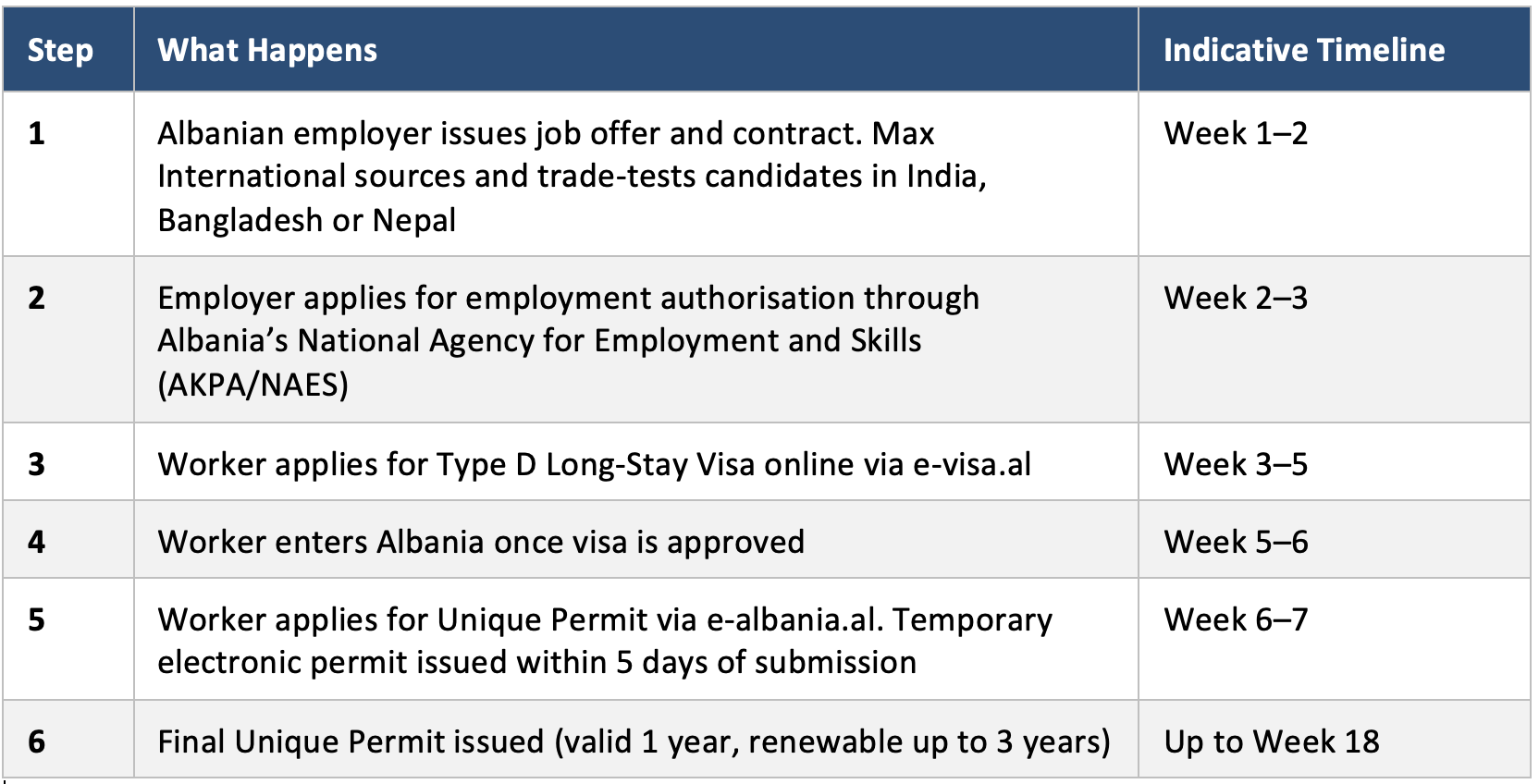
Important note: The weeks shown above are indicative based on standard processing observed under normal conditions. Actual timelines can extend due to delays in document submission, missing apostille or translation, or employer-side authorisation delays at AKPA/NAES. Max International does not promise or guarantee a fixed visa or permit issuance date. We commit to managing our side of the process efficiently and keeping all parties updated transparently.
Documents required from the candidate side
Passport valid for at least 6 months beyond intended stay
Police clearance certificate, apostilled and translated into Albanian
Medical fitness certificate
Employment contract signed by the Albanian employer
Trade or skill certificates where applicable
Health insurance covering Albania
Passport-size photographs (47 x 36 mm specification per the e-Visa portal)
All documents must be in Albanian or officially translated. The employer is required to report the worker’s start of employment within 8 days of joining.
6. How Max International Supports Albanian Employers and South Asian Candidates
Max International works with the Albanian market through two engagement models ↔ direct partnerships with Albanian employers or B2B partnerships with local Albanian recruitment companies. Both routes are designed to give Albanian businesses access to a verified, trade-tested South Asian workforce without managing multiple agencies across countries.
For Albanian Construction, Tourism and Manufacturing Companies (Direct Engagement)
If you are an Albanian employer hiring directly without going through a local Albanian agency, Max International becomes your direct recruitment partner in South Asia. We work with your HR or project team to:
Define exact role specifications, volumes and timelines
Source and trade-test candidates against your requirements at our facilities in India and Bangladesh
Share verified candidate profiles for your selection
Handle police verification, medical clearance, apostille, translation and visa documentation in the source country
Coordinate departure logistics so workers arrive ready to start
For Albanian Recruitment Companies (B2B Partnerships)
If you are an Albanian recruitment agency placing workers into local construction, tourism or manufacturing projects, partnering with Max International gives you a structured pipeline from India, Bangladesh and Nepal.
Pre-tested candidates — from our in-house trade testing centres in India and Bangladesh, so your client receives a workforce ready to deploy
Volume hiring capacity — across multiple trades simultaneously, useful when a single Albanian project needs welders, masons, electricians and tilers together
Documentation coordination — police clearance, medical, apostille and translation handled by Max in the source country
Single-source recruitment — instead of working with separate agents in three different South Asian countries
7. Our Operational Advantage
MEA-licensed in India since 2005 —RA No. 0088/DEL/PER/1000+/5/7108/2005
In-house physical trade testing centres in India and on-site testing in Bangladesh
Active recruitment pipeline across India, Bangladesh, Nepal and Sri Lanka
20 years of experience placing workers across GCC, Southeast Asia and now European markets
For Indian, Bangladeshi and Nepalese Candidates
If you are a skilled or semi-skilled worker considering Albania, Max International supports you through trade testing, document preparation, visa coordination and pre-departure briefing, and only places you with verified Albanian employers
👉 Talk to the MAX International Team or view Current Openings
Frequently Asked Questions
Q1. Can Indian workers legally work in Albania in 2026?
Yes. Indian workers can legally work in Albania under Law on Foreigners No. 79/2021. The process requires a Type D Long-Stay Visa applied through e-visa.al, followed by a Unique Permit applied through e-albania.al after arrival. The Unique Permit combines residence and work authorisation in a single document and is initially valid for one year, renewable up to three years.
Q2. Do Indian workers need eMigration clearance to work in Albania?
No. Albania is not on India's list of 18 ECR (Emigration Check Required) countries. Indian passport holders going to Albania for employment do not need Protector of Emigrants clearance, which makes the paperwork process simpler than the Gulf route.
Q3. What is the minimum wage in Albania for foreign workers in 2026?
The national minimum wage in Albania from 1 January 2026 is ALL 50,000 per month, approximately EUR 525 or ₹48,000. This was set by Council of Ministers Decision No. 776 dated 19 December 2025 and applies equally to Albanian and foreign workers based on 174 working hours per month.
Q4. How much do Indian workers earn in Albania?
Most Indian and South Asian workers in Albania earn between ALL 60,000 and ALL 86,000 per month (roughly EUR 600 to 900, or ₹55,000 to ₹82,000) depending on the sector, trade and experience level. INSTAT data places the average gross monthly wage in early 2026 at ALL 82,000 to 86,000. Skilled trades such as experienced welders and electricians typically earn at or above this average.
Q5. Which sectors hire Indian and South Asian workers in Albania?
The four highest-demand sectors are construction (welders, carpenters, electricians, masons, formwork specialists), tourism and hospitality (chefs, waitstaff, housekeeping), manufacturing and textiles (garment and assembly workers), and agriculture (seasonal field workers). Facility services such as cleaning, maintenance and security are also actively hiring.
Q6. How long does the Albania work visa process take?
The standard end-to-end timeline is approximately 6 to 18 weeks, depending on how quickly documents are prepared and submitted. The temporary electronic permit is issued within 5 days of Unique Permit submission, and the final permit can take up to 12 weeks. Timelines may extend due to incomplete documentation, missing apostille or translation, employer-side delays at AKPA/NAES, or seasonal application volume.
Q7. What documents do Indian workers need for an Albania work permit?
The required documents are: a passport valid for at least six months beyond intended stay, a police clearance certificate (apostilled and translated into Albanian), a medical fitness certificate, a signed employment contract from the Albanian employer, trade or skill certificates where applicable, health insurance covering Albania, and passport-size photographs to e-Visa portal specification (47 x 36 mm). All documents must be in Albanian or officially translated.
Q8. What is the difference between a Type D Visa and a Unique Permit in Albania?
The Type D Visa is the long-stay entry visa that allows a foreign worker to enter Albania for stays of more than 90 days. The Unique Permit is the combined residence and work authorisation issued after entry, which legally permits the worker to live and work in Albania. The Type D Visa is applied for online before travel; the Unique Permit is applied for after arrival via the e-Albania portal.
Q9. Can Albanian companies hire Indian workers directly?
Yes. Albanian construction, tourism, manufacturing and facility services companies can hire Indian workers directly by partnering with a licensed Indian recruitment agency such as Max International. The agency handles sourcing, trade testing, document preparation and visa coordination from India, while the Albanian employer manages employment authorisation through AKPA/NAES and the Unique Permit on the Albania side.
Q10. Is Albania a good destination for Indian workers compared to other European countries?
Albania offers several practical advantages for Indian workers. It is not on India's ECR list (no eMigrate clearance required), the Unique Permit timeline is faster than most Western European countries, competition for jobs is lower than established destinations such as Croatia or Poland, and Albania is an EU candidate country which means workers build a documented European work history. Wages are lower than Western Europe but markedly higher than typical Indian wages for the same trades.
Q11. Does Max International work with Albanian employers and recruitment agencies?
Yes. Max International works with the Albanian market through two engagement models ↔ B2B partnerships with local Albanian recruitment agencies, and direct partnerships with Albanian employers hiring at scale across construction, tourism, manufacturing and facility services. Max International is MEA-licensed in India (RA No. 0088/DEL/PER/1000+/5/7108/2005), and operates in-house trade testing centres in India and Bangladesh.
Q12. Can the visa or permit timeline be guaranteed?
No. Visa and permit timelines depend on multiple factors outside any agency's control, including document readiness, apostille and translation turnaround, employer authorisation processing at AKPA/NAES, visa appointment availability at the Albanian consulate, and seasonal application volume. Max International commits to managing the source-country process efficiently and keeping all parties updated, but does not promise fixed issuance dates.