Hiring Hospitality Workers from South Asia for GCC Jobs in 2026: Roles, Salaries and How the Recruitment Process Works
1. Why GCC Hospitality Demand for South Asian Workers Is Booming in 2026
Hospitality in the GCC is not a peak-season problem. It is a year-round workforce dependency built into the operating model of the region's hotel, F&B and tourism sectors for decades. The scale of that dependency is significant. The UAE hosted over 18.7 million international visitors in 2024, according to the Dubai Department of Economy and Tourism — a record figure driving continued investment in hotel capacity, branded F&B and entertainment infrastructure. Saudi Arabia's Vision 2030 targets 150 million tourist visits annually by 2030, with hospitality sector investment running into hundreds of billions of riyals. Qatar, Oman, Bahrain and Kuwait are each expanding hospitality infrastructure as economic diversification beyond hydrocarbons accelerates.
South Asian workers from India, Bangladesh, Nepal and Sri Lanka — fill the majority of operational hospitality roles across the GCC. This is the operating reality of the sector in 2026, not a gap domestic labour is expected to close. What has changed is the standards. Hotels and F&B operators are no longer simply filling headcount. They are looking for workers who arrive with documented experience, verifiable trade skills and the ability to meet international service standards from day one Saudi Vision 2030 — Tourism Targets.
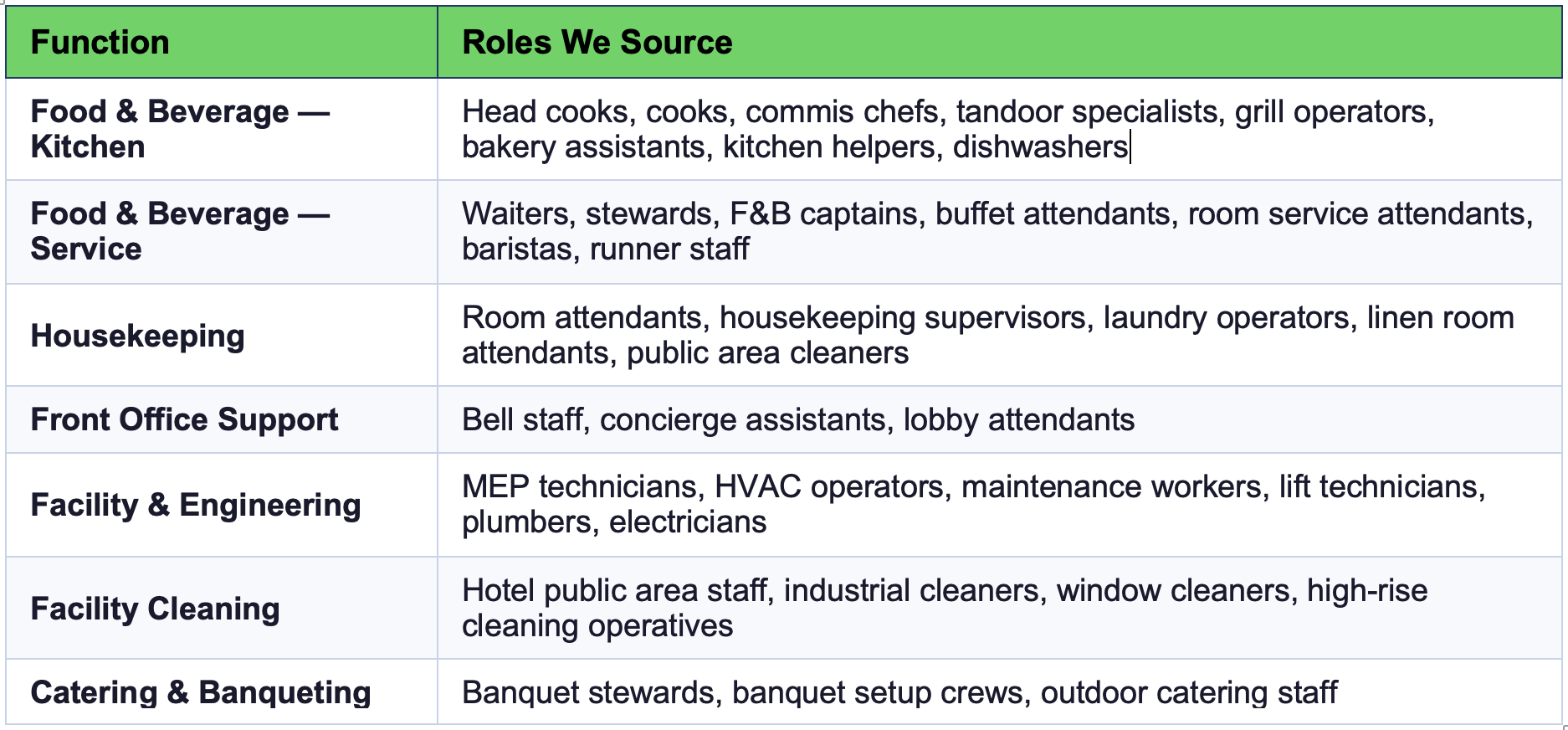
2. Roles Max International Can Supply — GCC Hospitality Trades
Max International sources and places candidates across the full range of operational hospitality roles. Every candidate is trade-tested at our in-house facilities before their profile reaches an employer.
3. GCC Countries With Active Hospitality Demand in 2026
All six GCC markets are actively hiring South Asian hospitality workers. The table below shows current demand drivers and the primary hiring locations within each country.
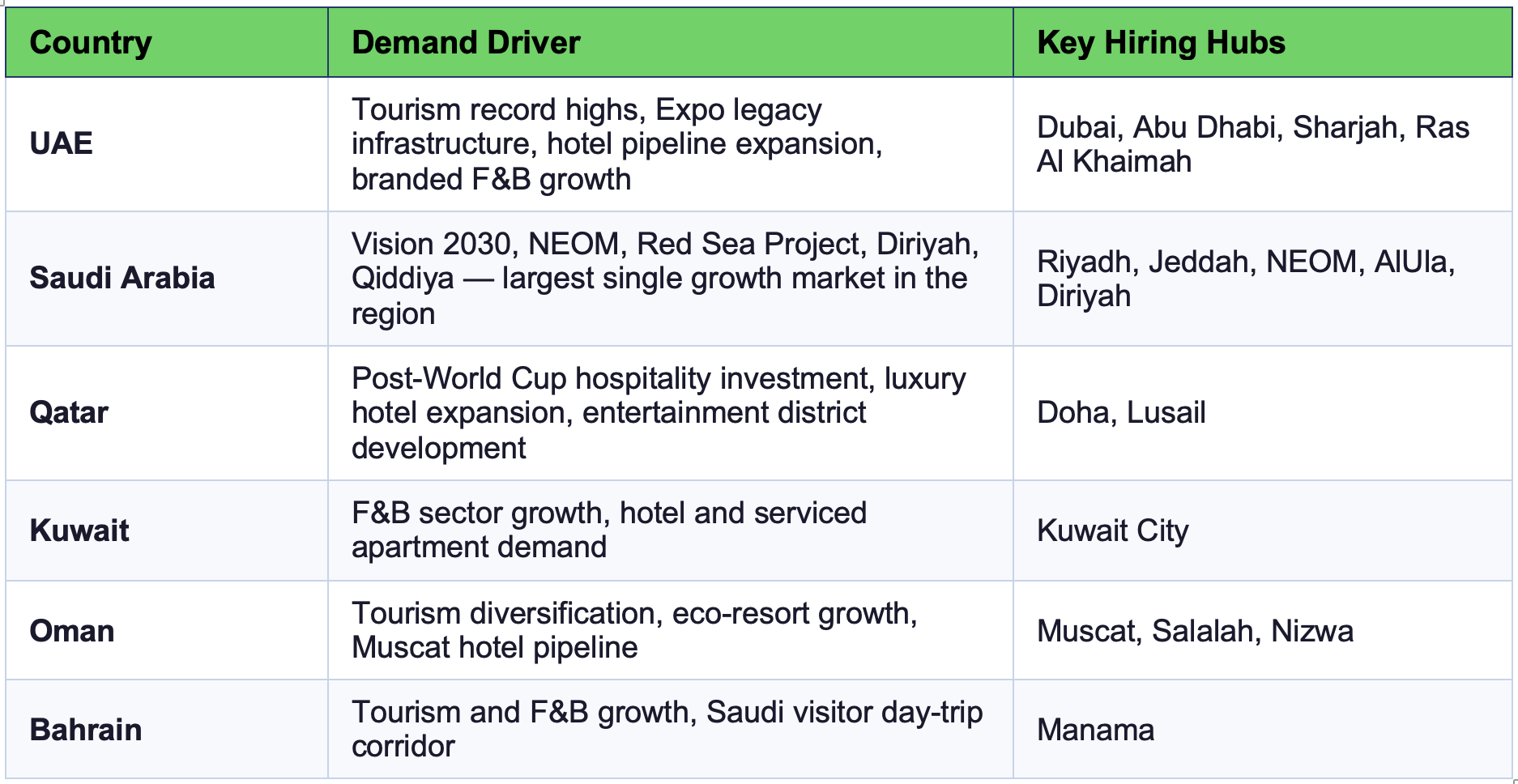
Saudi Arabia represents the largest single growth opportunity in the region. The hospitality workforce requirements tied to giga-projects — NEOM, the Red Sea Project, Diriyah, Qiddiya are expected to run through the end of the decade. Kitchen, housekeeping and F&B service workers are among the most consistently requested trades across all six GCC markets.
4. Experience and Skill Requirements & What GCC Employers Expect
GCC hospitality employers, particularly branded hotel groups operating under international flags, set clear expectations around candidate experience and practical skill. The table below reflects standard requirements across role categories.
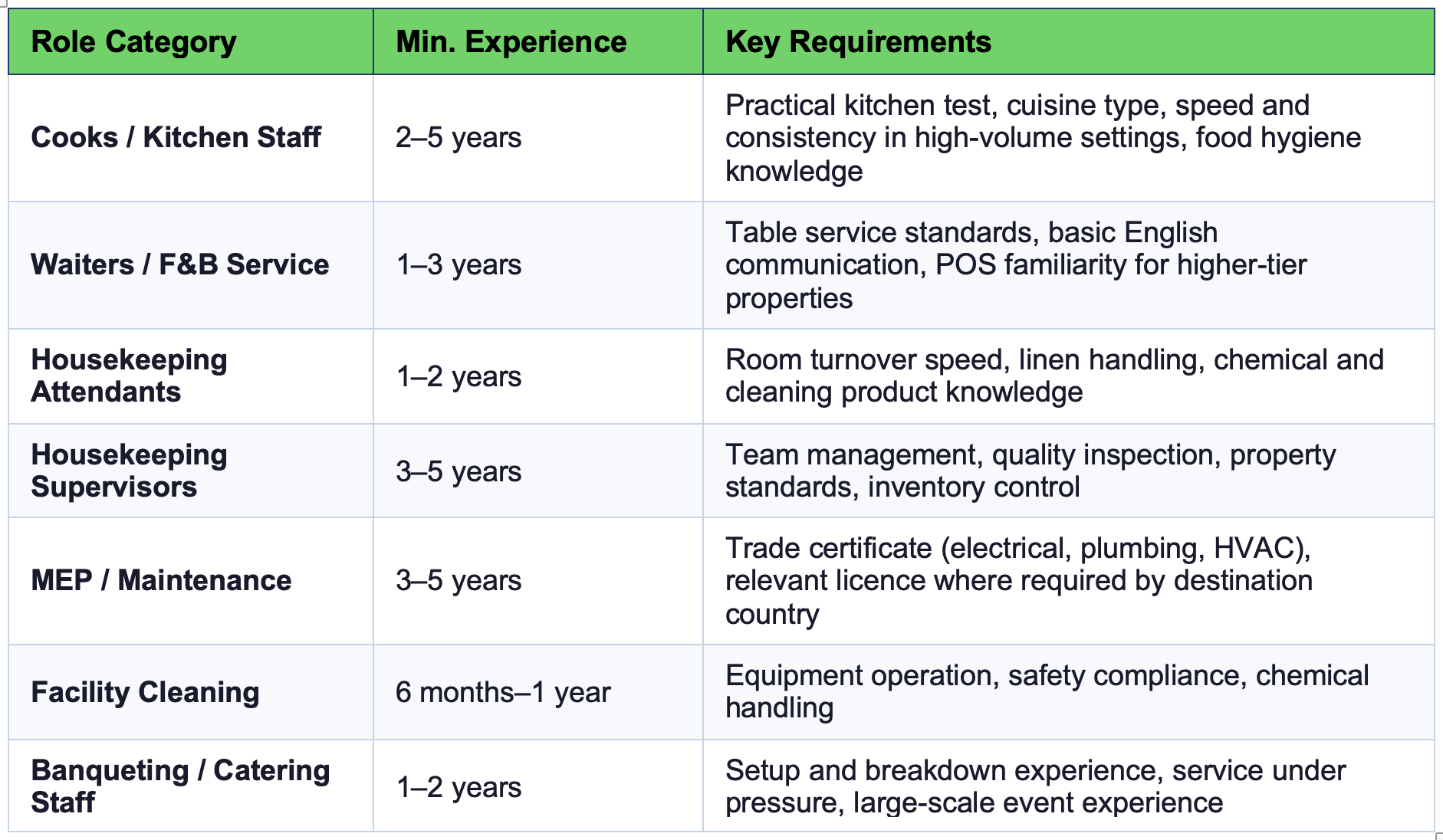
Important note: Max International assesses all candidates against role-specific criteria at our in-house trade testing centres in India and on-site in Bangladesh before any profile is shared with an employer. For kitchen roles, practical cooking assessments are conducted. For MEP and maintenance, technical skill is evaluated. For service and housekeeping, operational competency is assessed against the employer's property category and standards.
5. What South Asian Hospitality Workers Earn in the GCC
Salaries in the GCC hospitality sector vary by country, property tier, role, experience and package structure. The figures below are indicative based on standard industry packages across the GCC market.
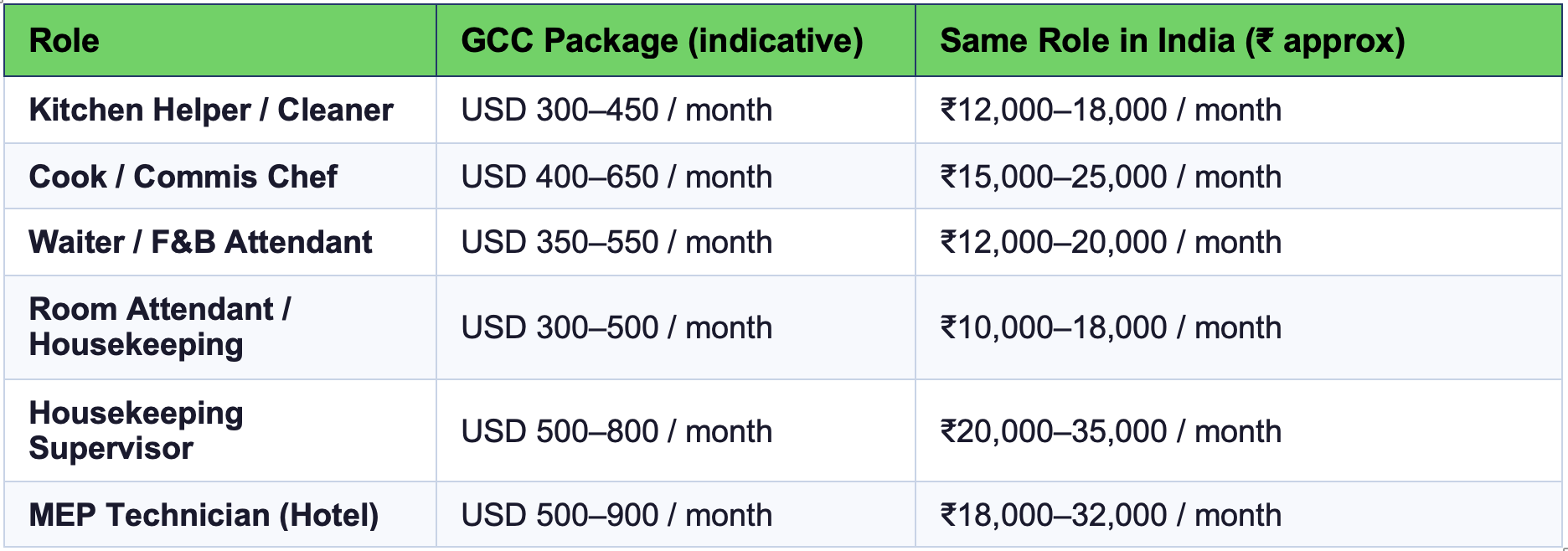
Indicative ranges based on standard GCC hospitality market packages. Actual offers vary by property tier, employer, country and contract terms. GCC earnings are generally tax-free for the worker. Most packages include employer-provided accommodation, transport to worksite and meals or a meal allowance — meaning the effective income value is higher than the base figure alone.
6. The Work Permit Process ➡ Step by Step Across GCC Markets
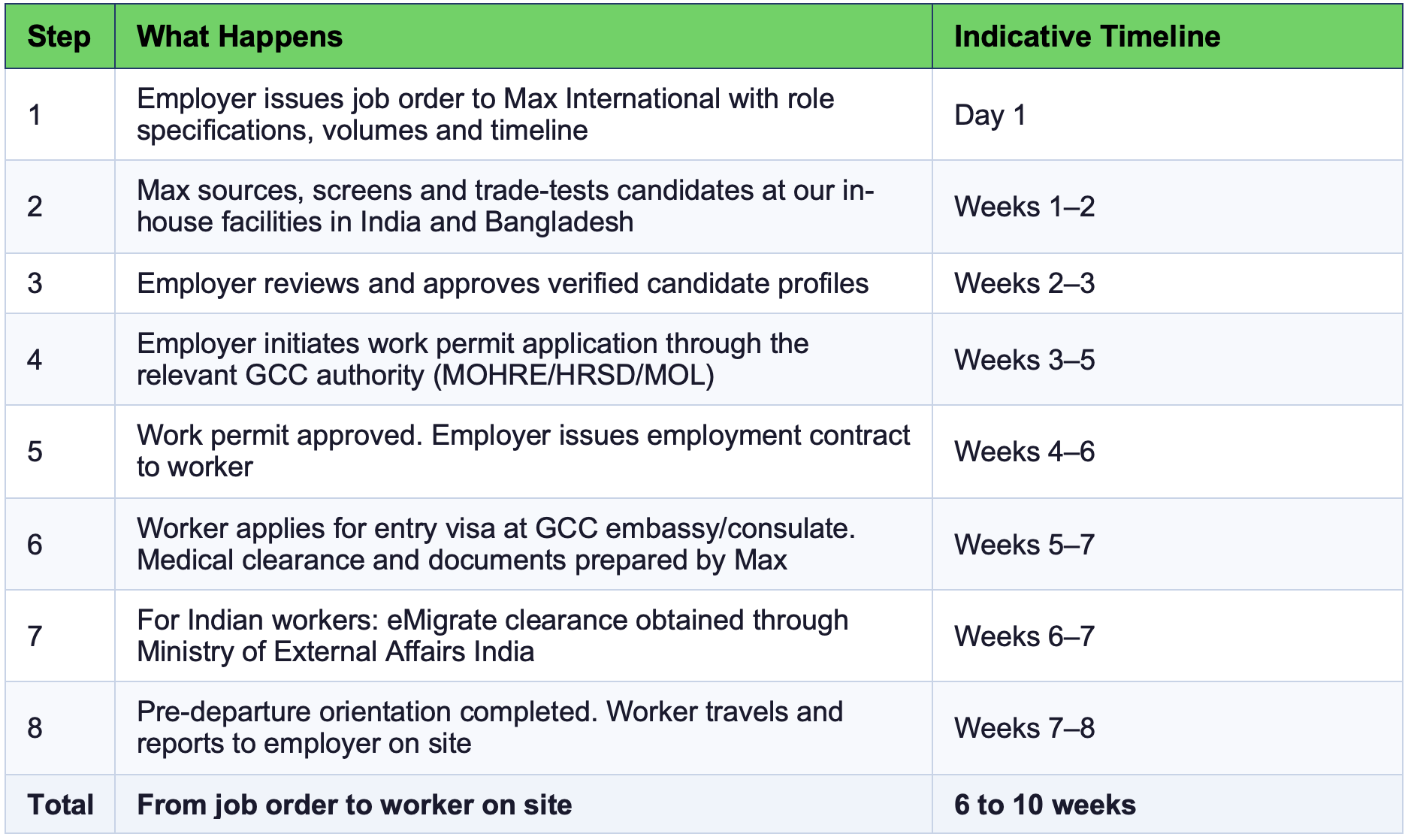
Important: Timelines above are indicative based on standard processing under normal conditions. Actual timelines can extend due to document delays, medical clearance scheduling, visa appointment availability at embassies or consulates, or seasonal application volumes. Max International does not promise or guarantee fixed permit or visa issuance dates. We commit to managing the source-country process efficiently and keeping all parties updated throughout.
7. How Max International Supports GCC Employers and South Asian Candidates
For GCC Hotels, F&B Operators and Facility Management Companies
If you are a GCC employer hiring hospitality staff at scale — whether a single property or a multi-site group — Max International works as your direct source-country recruitment partner across India, Bangladesh, Nepal and Sri Lanka.
Role-specific sourcing — kitchen, housekeeping, F&B service, MEP, facility cleaning and catering staff
Trade testing before submission — candidates are assessed at our in-house testing centres before their profile reaches you
Full documentation management — medical clearance, police verification, eMigrate clearance for Indian workers, BMET for Bangladeshi workers, visa support handled end to end
Volume hiring capability — if your project requires 20 housekeepers, 15 cooks and 30 F&B attendants simultaneously, we build the team around your exact specifications
Single point of contact — one agency relationship managing multiple source countries, not separate sub-agents in three or four countries
For South Asian Candidates
If you have experience in hotel kitchens, food service, housekeeping or facility management and want to work in the GCC, Max International evaluates your skills, manages your documentation and connects you with verified GCC employers.
Skills assessment at our trade testing centres — evaluated against real employer standards
Document preparation — eMigrate clearance, medical, police certificate managed step by step
Employer verification — every employer we work with is verified before candidate profiles are submitted
Pre-departure support — orientation on GCC workplace standards, legal rights and what to expect on arrival
8. Our Operational Advantage
MEA-licensed in India since 2005 —RA No. 0088/DEL/PER/1000+/5/7108/2005
In-house physical trade testing centres in India and on-site testing in Bangladesh
Active recruitment pipeline across India, Bangladesh, Nepal and Sri Lanka
20 years of experience placing workers across GCC, Southeast Asia and now European markets
👉 Talk to the MAX International Team or view Current Openings
Frequently Asked Questions
Q1. Which GCC countries are currently hiring South Asian hospitality workers?
All six GCC countries — UAE, Saudi Arabia, Qatar, Kuwait, Oman and Bahrain have active hospitality hiring for South Asian workers. Saudi Arabia currently represents the largest growth opportunity due to Vision 2030 giga-project requirements. UAE remains the most established corridor with the highest volume of active placements.
Q2. What hospitality roles does Max International recruit for?
Max International recruits across kitchen (cooks, commis chefs, kitchen helpers, tandoor and grill specialists), F&B service (waiters, stewards, captains, room service), housekeeping (room attendants, supervisors, laundry), facility maintenance (MEP technicians, plumbers, electricians), banqueting and catering, and facility cleaning roles.
Q3. Do candidates need formal certificates or is experience enough?
Requirements vary by role and employer. For kitchen roles, practical skill is the primary assessment — our trade testing evaluates actual cooking performance, not just documents. For MEP and maintenance roles, trade certificates are typically required. For housekeeping and F&B service, documented work experience with a verifiable employer is generally sufficient.
Q4. How long does the GCC hospitality work permit process take?
The standard end-to-end timeline is approximately 6 to 10 weeks from job order to worker on site. This includes candidate sourcing and testing, employer approval, work permit processing, visa application and pre-departure. Timelines can extend due to documentation delays or processing backlogs. Max International does not guarantee fixed timelines.
Q5. Can Max International recruit from India, Bangladesh and Nepal simultaneously for one employer?
Yes. Max International has an active recruitment pipeline across India, Bangladesh, Nepal and Sri Lanka. If an employer requires a mixed team — for example, Indian cooks alongside Bangladeshi housekeeping staff — we coordinate sourcing across source countries and deliver consolidated candidate profiles.
Q6. Are GCC salaries tax-free for South Asian workers?
Yes. Workers employed in GCC countries are generally not subject to personal income tax on their earnings. The take-home figure is therefore significantly closer to the gross package than in European destinations. Most GCC packages also include employer-provided accommodation, transport and meals or a meal allowance.
Q7. How does Max International verify candidates before submission?
All candidates go through our in-house trade testing process at our facilities in India and on-site in Bangladesh. For kitchen roles, this includes practical cooking assessments. For maintenance roles, technical skill evaluation. For service and housekeeping, operational skills assessment. Candidates also go through document verification, identity check and basic medical pre-screening before their profile is shared with any employer.